



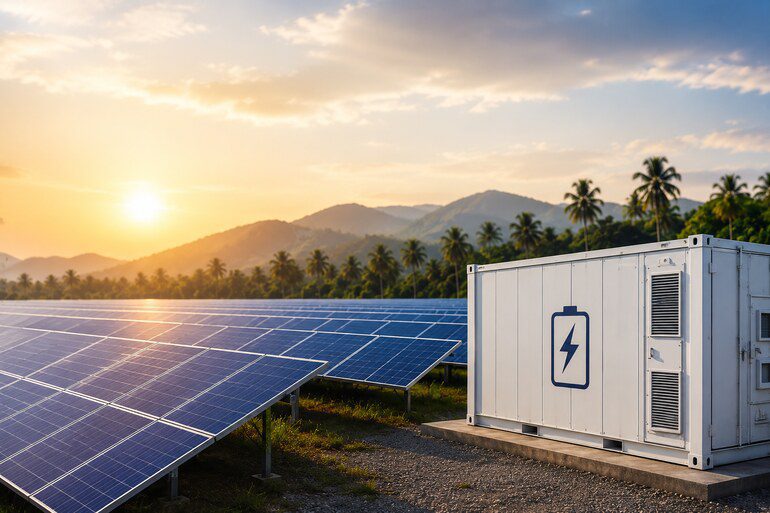
The Kerala State Electricity Regulatory Commission (KSERC) has approved Kerala State Electricity Board Limited’s (KSEB) proposal to procure 200 MW of solar power integrated with a 100 MW/400 MWh Battery Energy Storage System (BESS), marking an important step towards improving the state’s ability to meet peak electricity demand while expanding the share of renewable energy in its power mix.
The approval issued through a regulatory order enables KSEB to procure renewable power through the Solar Energy Corporation of India (SECI) under a long-term arrangement. The initiative is expected to strengthen grid reliability during high-demand periods while supporting Kerala’s clean energy and energy storage obligations.
Also Read: ENGIE Reaches Key Financing Milestone for 250 MW Khaba Solar Project
KSERC Approval Marks a Key Milestone
With the Commission’s approval, KSEB can move forward with procuring 200 MW of solar power bundled with battery energy storage under a 25-year agreement. According to the order, the procurement is based on a discovered tariff of ₹2.93 per kWh, offering a competitive renewable energy solution that combines clean power generation with dispatchable energy storage.
Battery storage will enable electricity generated during daylight hours to be stored and supplied during evening peak demand, improving system flexibility and reducing dependence on costly short-term power purchases.
Also Read: NTPC Gets Board Nod to Raise Up to ₹12,000 Crore Through Domestic NCD Issue
Project at a Glance
Key Highlights
- KSERC approves KSEB’s 200 MW solar-plus-storage procurement.
- Project includes a 100 MW/400 MWh Battery Energy Storage System (BESS).
- Power will be procured through the Solar Energy Corporation of India (SECI).
- Approved tariff stands at ₹2.93 per kWh.
- Procurement period extends for 25 years.
- Project aims to strengthen Kerala’s peak power supply.
- Supports Renewable Purchase Obligation (RPO) and Energy Storage Obligation (ESO) compliance.
Impact on Kerala’s Power Sector
Solar power generation reaches its highest levels during daytime, while electricity demand in many regions peaks during the evening. Battery Energy Storage Systems bridge this gap by storing excess solar energy and releasing it when demand rises.
For Kerala, integrating battery storage with solar power is expected to improve grid reliability, optimize renewable energy utilization, and reduce reliance on conventional power sources during peak hours. The combination of renewable generation and storage is increasingly becoming an important component of India’s evolving electricity system as states work toward higher renewable energy penetration while maintaining reliable power supply.
Also Read: SJVN Invites Bids for 250 MW/500 MWh Battery Energy Storage Project in Haryana
Supporting Kerala’s Clean Energy Transition
The approved procurement aligns with Kerala’s broader efforts to increase renewable energy adoption while meeting national renewable energy targets. Long-term procurement of solar power supported by battery storage also provides greater price certainty and operational flexibility compared with short-term market purchases.
The initiative is expected to contribute to cleaner electricity generation, improved energy security, and enhanced grid resilience as renewable energy continues to play a larger role in the state’s electricity portfolio.
KSERC Order Clears Way for Project Implementation
The KSERC order provides the regulatory clearance required for KSEB to proceed with the proposed procurement under the approved commercial framework. The Commission examined the proposal before granting approval, allowing the utility to advance implementation in accordance with the terms specified in the order.
The procurement represents another step in Kerala’s efforts to modernize its power infrastructure while integrating renewable energy with advanced storage technologies to meet future electricity demand efficiently.
What Happens Next
The approval of KSEB’s 200 MW solar-plus-storage procurement marks a significant development for Kerala’s power sector. By combining utility-scale solar generation with battery energy storage, the project is expected to improve peak power management, strengthen grid reliability, and support the state’s transition toward a cleaner and more resilient electricity system.
