



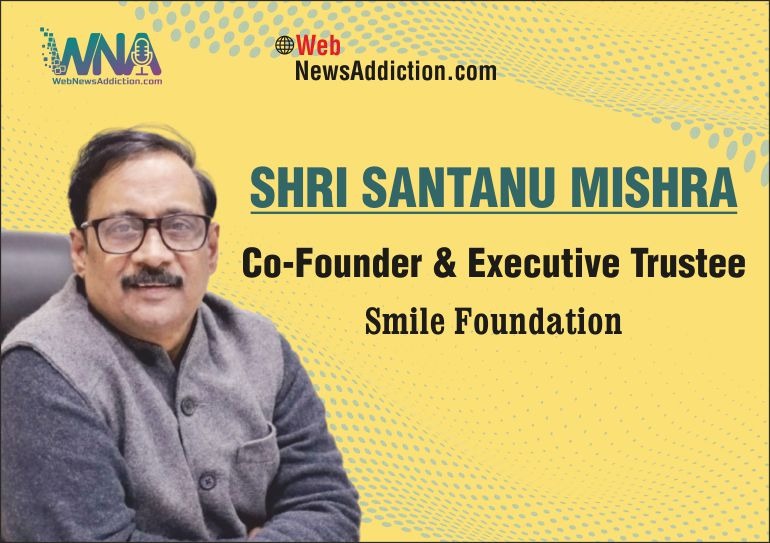
As India’s growth story becomes increasingly intertwined with sustainability, energy transition, and social inclusion, the need for leadership that can connect business ambition with community realities has never been greater. The challenge today is no longer growth alone, but how institutions can scale responsibly, create durable systems, and ensure that development reaches the last mile.
Few organizations reflect this philosophy as powerfully as Smile Foundation, which has built a far-reaching presence across 27 states and now impacts 2.5 million children and their families every year. At the heart of this journey is a deeper commitment to governance, continuity, and trust-led institution building.
It is within this larger framework that Mr. Santanu Mishra, an alumnus of IIM Ahmedabad, an associate member of the Institute of Company Secretaries of India (ICSI), and Co-Founder of Smile Foundation, offers a compelling perspective on leadership, ESG, grassroots innovation, and the partnerships required to build a more inclusive and resilient future. As a long-standing proponent of the Social Venture Philanthropy (SVP) movement in India, his views bring together governance discipline, systems thinking, and community-led institution building.
Also Read: https://webnewsaddiction.com/from-chaos-to-cohesion-indias-urban-mobility-awakening/
Scale as Continuity, Not Just Expansion
For Mr. Santanu Mishra, scale is not merely a measure of reach; it is a test of continuity. As Mr. Mishra says, “Scale has always been about continuity of impact.” For him, real scale is meaningful only when it preserves outcomes across generations. Under his leadership, Smile Foundation’s lifecycle approach has linked education, skilling, entrepreneurship, and primary healthcare into a holistic model of empowerment.
This integrated framework has enabled the organization to expand across 27 states while maintaining a strong connection to community aspirations. The emphasis has never been on numerical growth alone, but on building systems that ensure outcomes deepen over time rather than dilute with expansion.
At the heart of this philosophy lies a leadership model driven by governance, purpose-led culture, and collaboration among multiple stakeholders.
Responsible Growth Begins with Integration
Drawing from his experience with more than 400 corporate partners, Mr. Mishra emphasizes that growth and social responsibility must evolve together. In his words, “The future of responsible growth lies in integration.” He believes the strongest business models are those that integrate community value into long-term strategy.
He argues that social initiatives create the greatest value when they are embedded into long-term business strategy rather than positioned as standalone CSR exercises. Accountability, measurable outcomes, and social return on investment (SROI) must be treated with the same rigour as financial investments. This approach turns social responsibility into a strategic advantage; one that strengthens communities while reinforcing long-term business resilience.
Why Institution Building Matters in the Energy Transition
As India moves through a major energy transition, Mr. Mishra describes institution building as the bridge between ambition and equitable execution. As he notes, “Transitions of this scale require institutions that can sustain momentum over time.” He argues that without continuity between policy, infrastructure, and people, transitions struggle to remain inclusive.
Transitions of this scale demand continuity between policy, infrastructure, and community engagement. Without strong institutions to sustain momentum, even the most promising investments risk bypassing underserved geographies. His insight is especially relevant for sectors where the success of transition depends not only on capital, but on trust, adoption, and long-term delivery mechanisms.
ESG as a Core Business Discipline
For Mr. Mishra, the future of ESG lies in operational integration. Sustainability can no longer sit at the edges of corporate strategy; it must shape decision-making at the core.
Drawing parallels from Smile Foundation’s own long-term outcome tracking, he points out that organizations must move beyond reporting outputs to measuring sustained outcomes. As ESG increasingly influences capital allocation and risk management, this deeper integration will define future-ready leadership.
The shift also reflects a broader evolution in business thinking: sustainable growth is becoming inseparable from competitive growth.
The Last-Mile Lesson: Design Around Local Realities
One of the most compelling lessons from Smile Foundation’s grassroots work, Mr. Mishra notes, is that solutions succeed only when they are built around lived realities. As Mr. Mishra emphasizes, “Solutions work best when they are designed around local realities.” He repeatedly underscores that communities must see themselves in the design of every solution.
In underserved communities, the challenge is rarely just access. Reliability, affordability, and usability often determine whether a solution becomes transformative. This is why Mr. Mishra emphasizes decentralized energy pathways such as rooftop solar, mini-grids, clean cooking technologies, and localized storage systems.
These models reduce dependence on distant infrastructure while aligning more closely with local consumption patterns, geography, and income realities.
The principle is simple yet profound: communities must be able to own the solution for it to endure.
The Slow Work of Behavioural Change
Whether in education, healthcare, sustainability, or energy access, Mishra believes the greatest challenge is moving beyond awareness into long-term behavioural adoption. Meaningful change requires repeated engagement, visible benefits, and social reinforcement over time. This is where continuity once again becomes central.
The lesson is highly relevant for sustainability leaders: adoption is rarely immediate, but consistent reinforcement turns positive shifts into community norms.
Partnerships as Multipliers of Impact
A defining pillar of Mr. Mishra’s leadership journey has been collaboration. Through Smile Foundation’s Social Venture Philanthropy (SVP) model and its vast grassroots network, partnerships have become multipliers of scale.
For sectors like energy and sustainability, he believes the future lies in shared accountability between corporates, policymakers, non-profits, and local institutions. When aligned around measurable outcomes, such partnerships can convert capital into meaningful last-mile transformation.
A Leadership Blueprint for the Next Generation
For emerging leaders working at the intersection of business, sustainability, and impact, Mr. Mishra’s message is clear: conviction must be matched by disciplined systems. In one of the clearest lessons from his journey, he says this space “requires both conviction and discipline.” He believes purpose creates direction, but only execution builds institutions that endure.
Purpose creates momentum, but execution creates endurance. The leaders who will shape the future are those who can combine field realities with scalable models, measurable frameworks, and long-term institutional thinking.
In an era defined by ESG transformation, inclusive growth, and energy transition, Mr. Santanu Mishra’s philosophy offers a timely blueprint, not just for building organizations, but for building futures.
