



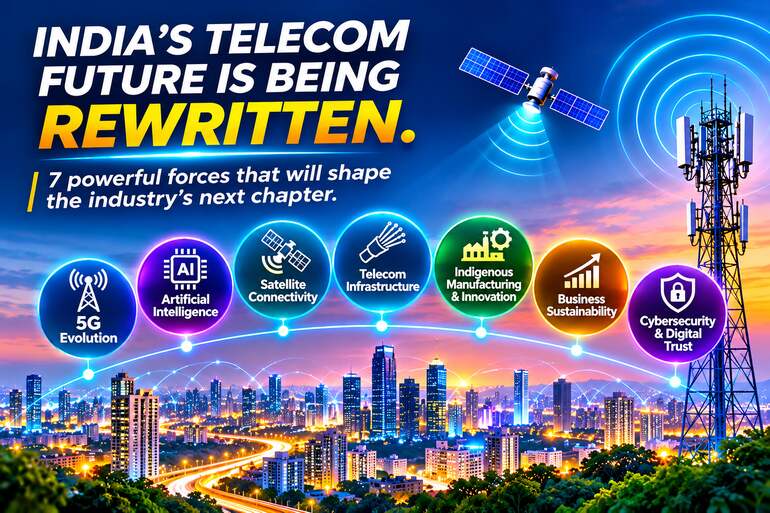
The Indian Telecom Industry is entering a new phase of transformation. Over the past decade, the country has made significant progress in expanding mobile connectivity, strengthening digital infrastructure and deploying next-generation networks. The rapid rollout of 5G has further accelerated this transformation, creating opportunities for businesses, consumers and technology companies across sectors.
However, the next chapter of the Indian telecom story will involve much more than faster internet speeds and wider network coverage. Artificial Intelligence (AI), satellite communications, cloud computing, optical fibre infrastructure and emerging 6G technologies are changing the way connectivity is delivered, consumed and monetized. At the same time, telecom operators face growing investment requirements, evolving consumer expectations, cybersecurity threats and the need for commercially sustainable business models.
The scale of India’s digital ecosystem makes these developments particularly significant. According to the Telecom Regulatory Authority of India (TRAI), the country’s total internet subscriber base reached approximately 1.11 billion at the end of June 2026, including 1.09 billion broadband subscribers. The average monthly wireless data consumption per subscriber stood at 28.39 GB during the April-June 2026 quarter. These figures highlight how deeply internet connectivity has become embedded in everyday life.
With such a large connected population, the Indian telecom Industry is no longer just an enabler of communication. It is becoming an essential foundation for India’s digital economy, supporting financial services, commerce, manufacturing, healthcare, education, transportation and public administration.
The question now is how effectively India can translate its expanding connectivity infrastructure into technological innovation, economic value and globally competitive telecom capabilities.
Beyond 5G Coverage: The Next Challenge Is Creating Real Business Value
India’s 5G rollout has been one of the most significant developments in its telecommunications journey. The technology has brought higher network speeds, lower latency and greater capacity, opening possibilities for applications that require faster and more reliable connectivity.
According to the Department of Telecommunications (DoT), 5G services were available in 99.9% of India’s districts as of 30th June, 2026. The number of 5G base transceiver stations increased to 5,62,971, compared with 1,40,623 in March 2023. This demonstrates the speed at which the country has expanded its 5G infrastructure.
However, the availability of a technology does not automatically translate into its commercial success. While consumers have benefited from faster downloads, smoother streaming and improved connectivity, the larger opportunity lies in how businesses can use 5G to transform their operations.
Consider a manufacturing facility where hundreds of machines operate simultaneously. With conventional connectivity, monitoring equipment, collecting production data and responding to operational issues may involve multiple systems and communication delays. A private 5G network could provide dedicated, reliable connectivity for machines, sensors, cameras and automated systems, allowing the facility to monitor production processes and respond to changes more efficiently.
Similarly, in logistics, connected vehicles and warehouses could exchange real-time information to improve fleet visibility, inventory management and delivery coordination. In healthcare, high-quality connectivity could support remote consultations, connected medical equipment and the transmission of diagnostic information.
Another important development is network slicing. This technology allows operators to divide a physical 5G network into multiple virtual networks, each configured to meet the requirements of a particular application. For example, a factory requiring highly reliable connectivity could use a specialized network segment, while another segment could support ordinary consumer internet traffic.
The challenge is to move these applications beyond pilot projects and demonstrations. Businesses must be able to identify measurable benefits, such as reduced downtime, improved productivity, better resource utilization and lower operating costs.
Telecom operators can tap into this opportunity by expanding their offerings beyond consumer data services and building solutions tailored to the needs of businesses and industries. The next phase of 5G growth will therefore depend on how effectively the industry connects technological capabilities with practical business requirements.
Also Read: Gopal Vittal Retains GSMA Chair Role as Industry Focuses on AI and Security
Artificial Intelligence: Transforming Both Telecom Networks and Connectivity Demand
Artificial Intelligence is emerging as one of the most influential technologies shaping the future of telecommunications. Its impact is likely to extend in two directions: improving the way telecom networks operate and increasing the demand for advanced connectivity.
Within telecom operations, AI can help operators analyze large volumes of network data, identify performance issues and predict equipment failures before they disrupt services. Instead of relying entirely on manual monitoring, operators can use intelligent systems to identify unusual network behaviour and take corrective action.
For example, during a major sporting event or a large public gathering, thousands of people may simultaneously use mobile networks to make calls, upload videos and access online services. AI-powered network management systems could analyze traffic patterns and help operators allocate available network resources more efficiently. This could improve network performance during periods of unusually high demand.
AI can also support predictive maintenance. Telecom networks depend on thousands of towers, power systems, antennas and other equipment. By analyzing performance data, AI systems can identify components that may be approaching failure, allowing maintenance teams to intervene before an outage occurs.
Energy efficiency is another important application. Mobile network infrastructure consumes electricity continuously. AI-based optimization can help adjust network resources according to traffic demand, potentially reducing unnecessary energy consumption.
However, AI is not only changing how telecom networks are managed. It is also increasing the demand for connectivity.
The growing use of generative AI, cloud-based applications and data-intensive services requires reliable networks capable of handling increasing volumes of information. Data centres, which provide the computing infrastructure for AI applications also depend on high-capacity fibre connections and reliable power and network infrastructure.
For instance, when a business uses an AI-powered customer service platform hosted in a cloud data centre, information must travel between the customer, the telecom network and the computing infrastructure. The quality and reliability of connectivity influence how quickly the service responds.
This creates an opportunity for telecom operators to become important infrastructure partners for the expanding AI economy.
At the same time, AI introduces questions around data protection, transparency, accountability and cybersecurity. TRAI’s release of draft guidelines on the responsible use of AI in telecommunication networks and services on 30th October, 2026 reflects the growing importance of establishing appropriate safeguards as these technologies become more deeply integrated into the sector.
The larger opportunity lies in building an ecosystem where AI improves network efficiency while telecom infrastructure supports the next generation of AI-driven services.
Satellite Communications: Extending Connectivity Beyond Traditional Networks
Satellite communications are emerging as an important addition to the telecommunications ecosystem, particularly in areas where conventional network infrastructure is difficult to establish.
India’s geography presents several connectivity challenges. Remote villages, mountainous regions, islands, border locations and maritime areas may not always be economically viable for extensive terrestrial network deployment. Building towers and laying optical fibre in such locations can involve considerable costs and logistical difficulties.
Satellite-based connectivity can help address some of these challenges by delivering communication services without depending entirely on ground-based infrastructure.
Consider a village in a geographically isolated region where installing mobile towers and connecting them through fibre is difficult. Satellite broadband could provide an alternative way to establish internet access for households, schools, healthcare centres and local businesses.
The technology could also play an important role during natural disasters. Floods, cyclones, earthquakes and landslides can damage mobile towers, power systems and fibre networks, disrupting communication when it is needed most. Satellite connectivity could provide an additional communication channel for emergency response teams, government agencies and affected communities.
Maritime connectivity is another potential application. Ships operating far from the coastline may require satellite-based communication for navigation support, operational coordination and access to information.
An important distinction however is that satellite communications are not necessarily intended to replace terrestrial mobile networks. Their economics, capacity characteristics and intended applications differ. In densely populated urban areas, terrestrial networks and fibre infrastructure are likely to remain central to everyday connectivity, while satellite systems can complement them in locations where conventional infrastructure has limitations.
Direct-to-device satellite connectivity is another emerging development. It aims to allow compatible smartphones and other devices to communicate directly with satellites, potentially providing basic connectivity in areas without terrestrial coverage. The actual services available will depend on device compatibility, spectrum arrangements, satellite capacity and regulatory approvals.
The regulatory environment is also evolving. On 05th November, 2026, TRAI issued recommendations for a separate authorization framework for satellite communication network providers. The proposed framework includes a model under which satellite network providers can offer network capacity as a service to eligible telecom service providers rather than directly supplying telecom services to end users.
As satellite technology advances, questions around spectrum allocation, interference, security, pricing and coordination with terrestrial networks will become increasingly important.
The opportunity is not simply to introduce another connectivity technology, but to build a more comprehensive network ecosystem capable of serving India’s varied geographical and communication requirements.
Fibre and Data Centres: The Foundations of a Connected India
While 5G and satellite communications often dominate discussions about the future of telecom, the underlying infrastructure supporting these technologies deserves equal attention.
Wireless connectivity may reach users through mobile towers, but those towers need to be connected to the wider network. This is where optical fibre and backhaul infrastructure become essential.
Optical fibre carries large volumes of information over long distances using light signals. It provides the high-capacity connectivity required to connect mobile towers, data centres, enterprise facilities and internet exchange points.
For example, when a mobile user streams a high-definition video, the data may travel from a content delivery platform or data centre through multiple network links before reaching the user’s device. Without sufficient fibre capacity, the overall network could experience congestion even if the mobile connection itself supports high speeds.
This is particularly important as data consumption increases and more applications begin relying on real-time communication.
The expansion of data centres is adding another dimension to this requirement. Cloud computing, digital payments, online commerce, AI applications and enterprise software all depend on computing and storage infrastructure. These facilities need reliable, high-capacity network connections to communicate with users and other data centres.
Fixed broadband also has an important role to play. While mobile networks offer convenience and mobility, fibre-to-the-home connections can provide stable, high-capacity internet access for households, offices and institutions.
The government’s BharatNet programme is another important part of India’s digital infrastructure strategy, aiming to expand broadband connectivity to Gram Panchayats and rural areas.
However, connecting a village through fibre is only one part of the challenge. The infrastructure must also be operational, maintained and connected to local distribution networks so that households, schools, healthcare facilities and businesses can actually access affordable broadband services.
Right-of-way permissions, infrastructure-sharing arrangements, deployment costs and local implementation capacity will continue to influence the pace of expansion.
The larger point is that India’s digital future will depend on an integrated infrastructure ecosystem comprising mobile towers, optical fibre, data centres, satellites and last-mile broadband networks. Investment in wireless technology must therefore be supported by equally strong investments in the infrastructure beneath it.
From Telecom Imports to Homegrown Technology: India’s Next Big Opportunity
India’s telecom ambitions are increasingly extending beyond deploying technologies developed elsewhere. The country has an opportunity to strengthen its position as a manufacturer, developer and exporter of telecom products and solutions.
Telecom equipment manufacturing includes a wide range of products, from network routers, optical transmission systems and antennas to radio equipment and other components used in mobile networks.
Strengthening domestic manufacturing can help reduce import dependence, improve supply-chain resilience and create opportunities for Indian companies to participate in global telecom markets.
However, manufacturing equipment and developing original technology are different capabilities. A country may assemble or manufacture products using imported components and designs without necessarily owning the underlying intellectual property.
To become a more influential player in the global telecom ecosystem, India will need to strengthen research and development, component manufacturing, semiconductor capabilities, testing infrastructure and technology standardization.
The government’s Production Linked Incentive (PLI) scheme for telecom and networking products, with an approved outlay of ₹12,195 crore, is one of the initiatives aimed at encouraging domestic manufacturing.
The Telecom Technology Development Fund is also supporting research in areas such as indigenous 5G technology, 6G, optical systems, satellite and non-terrestrial networks, quantum communication and telecom security.
For example, the development of an indigenous 5G radio or network component could create opportunities for Indian manufacturers to supply domestic telecom operators. If the product meets international performance and quality requirements, it could also become a potential export opportunity.
Startups and academic institutions will have an important role in this ecosystem. Research institutions can develop new technologies, startups can turn innovations into commercial products, and established manufacturers can help scale production.
India’s 6G ambitions make this opportunity even more significant. The Bharat 6G Alliance, which had expanded to 90 members by July 2026 brings together telecom operators, equipment manufacturers, startups, research institutions and academia to strengthen the country’s research and innovation ecosystem.
The challenge is to convert these collaborative efforts into commercially viable products, intellectual property and technologies that can compete globally.
The Economics of Telecom: Balancing Affordability and Investment
One of the most important issues shaping India’s telecom future is the financial sustainability of the industry.
Telecom operators operate in a capital-intensive environment. Building networks, acquiring spectrum, expanding fibre infrastructure, installing equipment and maintaining service quality require continuous investments.
At the same time, consumers expect affordable mobile and broadband services. This creates a business challenge: operators must balance competitive pricing with the need to generate sufficient revenue to support future network investments.
The scale of data consumption makes this particularly important. TRAI’s April-June 2026 performance indicators recorded average monthly wireless data consumption of 28.39 GB per subscriber. During the same quarter, the average revenue realized per GB of wireless data was ₹7.13.
These figures illustrate how consumers are using substantial amounts of data while the industry must continue investing in the infrastructure needed to carry that traffic.
For telecom operators, improving financial performance will require more than increasing the number of subscribers. Developing enterprise connectivity services, private networks, managed solutions, cloud connectivity and other specialized offerings could provide additional revenue opportunities.
Infrastructure sharing can also help reduce costs. Instead of every operator independently building all elements of network infrastructure, certain facilities can be shared where technically and commercially feasible.
For consumers, the long-term objective should be to maintain affordable connectivity while ensuring that service providers have sufficient resources to improve network quality and expand coverage.
A financially sustainable telecom ecosystem is important not only for operators but also for the wider digital economy that depends on their networks.
As Connectivity Expands, So Do the Challenges of Network Security
As telecom networks become increasingly integrated with essential services, cybersecurity is becoming a central industry priority.
Mobile networks and broadband infrastructure support digital payments, banking, government platforms, healthcare services, transportation systems and business operations. Any significant disruption can have consequences extending well beyond the telecom sector.
The nature of threats is also changing. Cybercriminals are increasingly using sophisticated techniques, including AI-enabled tools to conduct phishing attacks, impersonate users, exploit vulnerabilities and target digital infrastructure.
For telecom operators, security challenges extend across network equipment, software systems, customer databases, signalling infrastructure and third-party service providers.
Consider a situation in which a cyberattack disrupts connectivity to a financial institution or a critical public service. The impact could affect thousands of users and businesses that depend on uninterrupted access.
Similarly, a vulnerability in connected devices used in industrial facilities could expose operational systems to security risks.
This makes network resilience essential. Operators must invest in continuous monitoring, threat detection, secure software updates, access controls and incident-response capabilities.
Data privacy is equally important. As telecom networks process increasing amounts of information, businesses must ensure that personal data is handled responsibly and in accordance with applicable laws and regulations.
The introduction of new technologies such as satellite communications, network slicing and AI also creates fresh security considerations. The regulatory framework must evolve to address these risks without unnecessarily restricting innovation.
Ultimately, the future of telecom will depend not only on how much data networks can carry, but also on how securely and reliably they can deliver it.
The Road to 6G: Preparing for the Next Technology Generation
Even as India continues to expand and monetize 5G, attention is gradually shifting towards 6G.
The next generation of mobile technology is expected to explore more advanced connectivity capabilities, potentially supporting applications involving intelligent networks, advanced sensing, immersive communication and highly connected devices.
However, 6G remains a developing area of research and standardization. Its eventual capabilities, commercial applications and deployment timelines will depend on international standards, technological breakthroughs, spectrum availability and the readiness of the wider ecosystem.
For India, preparation must begin well before commercial deployment. This means investing in research, developing indigenous technologies, building testbeds, strengthening academic-industry partnerships and participating in international standard-setting processes.
The lessons from 5G are important. Developing advanced network capabilities is only one part of the journey. The industry must also identify applications that solve real problems and create sustainable business opportunities.
India has an opportunity to approach 6G with a stronger focus on indigenous research, technology ownership and global collaboration.
India’s Telecom Future Will Depend on More Than Connectivity
India has made considerable progress in expanding telecom infrastructure and bringing millions of people into the digital ecosystem. The next stage, however will require a broader approach to growth.
5G must move beyond coverage and deliver measurable value to businesses and consumers. AI must improve network efficiency while supporting the growing demand for digital infrastructure. Satellite communications must complement terrestrial networks and extend connectivity to underserved locations. Optical fibre, data centres and broadband infrastructure must keep pace with rising data requirements.
At the same time, India must strengthen domestic telecom manufacturing, encourage innovation, improve cybersecurity and create a regulatory environment that supports technological progress.
The opportunities are significant, but they will not materialize through technology deployment alone. They will require sustained investment, collaboration between industry and government, research and development, and commercially viable applications.
The next chapter of India’s telecom journey will therefore be defined not simply by how fast networks become, but by how effectively they support businesses, improve public services, enable innovation and create economic value.
India has built a strong foundation for digital connectivity. The challenge now is to turn that foundation into a globally competitive, secure and sustainable telecom ecosystem.
References:
- TRAI – Telecom Subscription Data, June 2026
Internet subscribers, broadband connections and mobile data consumption. - TRAI – Indian Telecom Services Performance Indicators, April-June 2026
Telecom industry statistics, revenue and data usage. - Department of Telecommunications – Status of 5G Rollout
5G network expansion and adoption of 5G use cases in India. - PIB – Bharat 6G Alliance and Spectrum Roadmap
India’s 6G research, innovation and technology development plans. - Department of Telecommunications – Telecom Technology Development Fund
Indigenous telecom technology, R&D and innovation initiatives.
