



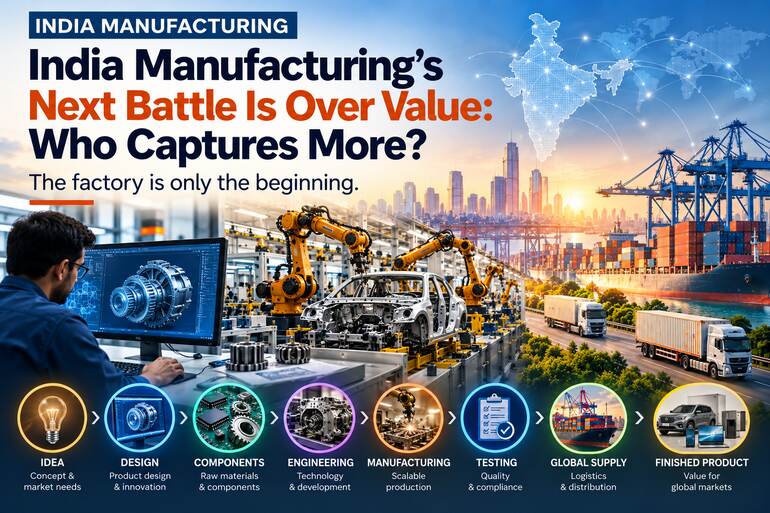
India has been building its manufacturing base. Now, the bigger question is how much value it can create from it. That shift is putting India’s manufacturing under a sharper spotlight, with ambitions extending from assembly to design, engineering, components and finished goods.
For years, the country’s manufacturing story has often been associated with increasing production, attracting factories and becoming part of global supply chains. But the next step is more ambitious: capturing a larger share of the value created between the initial design of a product and the finished good that reaches the customer.
That idea was highlighted by Hon’ble Minister for Commerce and Industry Shri Piyush Goyal at the G20 Trade Ministers’ Meeting in Milwaukee, where he said India is building manufacturing value chains from design to finished goods and positioning itself as a trusted link in global supply chains.
The comment deserves attention not simply because it was made at a G20 meeting, but because it points to a larger question for India’s industrial future: Can India move from being a place where products are assembled to becoming a place where more of the product’s value is designed, developed, manufactured and delivered?
Manufacturing Is About More Than the Factory
A finished product may look as though it comes from a single factory, but modern manufacturing rarely works that way.
A smartphone, automobile, medical device or piece of industrial equipment can involve hundreds of suppliers and several stages of production. Product design and engineering may take place in one location, research and development in another, and specialized components may come from several different companies. Processing, assembly, testing, packaging and distribution then complete the journey.
This entire network is commonly described as a manufacturing value chain. For India, the opportunity is not simply to increase the number of factories operating within the country. It is to increase the number of stages of that value chain that can be performed competitively in India. That is a much bigger proposition than building more production lines.
From “Made in India” to More Value Made in India
Consider two simplified versions of the same product. In the first model, India imports most components, assembles them domestically and exports the finished product. In the second, the product is designed or engineered in India, critical components are sourced from Indian suppliers, manufacturing and assembly take place domestically, testing is carried out locally and the finished product is exported from India.
Both models qualify as manufacturing. However, the second model captures a larger share of the product’s economic value within the country.
It also creates opportunities for a much wider group of businesses, including component manufacturers, engineering companies, technology providers, logistics firms, testing laboratories and smaller specialized suppliers.
This is why the phrase “from design to finished goods” is important. It points towards a manufacturing ecosystem rather than the establishment of an individual manufacturing facility.
The Value Beyond Assembly
The highest-value part of a product is not necessarily the physical assembly. Design, engineering, intellectual property, product development, specialized components, software, testing and after-sales capabilities can all influence where economic value is created. This is particularly relevant as manufacturing becomes more technology-intensive.
An electric vehicle, for example, is not simply a vehicle assembled on a production line. Its value chain can include battery technology, power electronics, software, motors, sensors, engineering, materials and component manufacturing.
Similarly, electronics manufacturing can extend well beyond final assembly into chip design, components, displays, batteries, printed circuit boards, testing and specialized manufacturing equipment. The more capabilities India develops across these stages, the deeper its participation in global value chains can become.
India’s Opportunity in a Changing Supply Chain
There is another reason this discussion is gaining importance. Global manufacturers are increasingly thinking about the resilience and diversification of their supply chains.
A company that depends heavily on a single country or region for critical components can face significant disruption when geopolitical tensions, trade restrictions, logistics problems or other shocks occur. That creates an opportunity for countries that can offer reliable alternatives. India wants to position itself as one of those alternatives.
However, becoming a trusted manufacturing partner requires more than a large domestic market. Global companies also need dependable suppliers, infrastructure, skilled workers, quality systems, logistics, technology capabilities and predictable access to international markets.
Supply chain diversification can open the door, but manufacturing competitiveness determines who benefits from the opportunity.
The Overcapacity Debate
This is where the Commerce Minister’s comments at the G20 meeting become particularly relevant. The global debate is not simply about whether countries should manufacture more. It is also about what happens when production capacity becomes significantly larger than market demand and whether government support can distort competition.
At the G20 meeting, Shri Piyush Goyal argued that industrial capacity itself is not the problem. He said India does not have structural excess capacity in the sectors identified by the G20 Presidency and that its manufacturing capacity serves both domestic and global demand.
He also acknowledged concerns about trade-distorting support that can contribute to dumping and predatory pricing, while arguing that such concerns should be addressed through evidence-based, WTO-consistent measures such as anti-dumping and countervailing duties.
The distinction is important. Building manufacturing capacity is not the same as creating excess capacity. A country can deliberately develop new industries because domestic demand is growing and because global customers are looking for additional sources of supply. The more important question is whether that capacity is competitive, commercially sustainable and integrated into genuine market demand.
The Economic Case for More Value Addition
There are several reasons why deeper manufacturing value chains could matter for India. If more components, engineering and production stages happen within India, a larger share of the economic value associated with a finished product can potentially remain within the domestic economy.
A stronger supplier network could also create new opportunities for smaller companies supplying components, tools, materials, maintenance, logistics and specialized services. Moving into design, engineering, research and development and advanced manufacturing could create more sophisticated employment opportunities beyond traditional factory work.
A deeper manufacturing ecosystem may also help Indian companies develop products specifically for international markets instead of producing goods mainly on behalf of foreign brands. In strategically important sectors, a broader domestic supplier base could reduce dependence on imported inputs and improve supply-chain resilience.
None of this happens automatically. Building a factory is one task. Building the ecosystem around that factory is considerably harder.
The Real Challenge: Can India Capture the Higher-Value Stages?
This is perhaps the most important question behind India’s manufacturing strategy. India has already demonstrated that it can attract large-scale manufacturing investment and become an important production location. The next challenge is to deepen localization.
That means looking beyond the number of factories or the size of installed production capacity. It means asking whether critical components are being made in India, whether Indian companies are developing their own products and technologies, and whether more research and development is taking place domestically.
It also means examining whether Indian suppliers are becoming global suppliers rather than serving only factories within India, and whether exports increasingly reflect Indian value addition instead of imported inputs assembled for overseas markets.
These are harder measures, but they provide a clearer picture of whether India is genuinely moving up the manufacturing value chain.
The Shift from Assembly to Innovation
The latest G20 comments are consistent with a broader message the Commerce Minister has been delivering to Indian industry.
In May 2026, he urged companies to move from “assembled in India” to “designed, engineered and manufactured in India.” He also called for deeper value chains, greater value addition, stronger research and development, more innovation and globally competitive quality standards.
That makes the Milwaukee statement more significant. It suggests that India’s manufacturing ambition is not limited to attracting more assembly lines. The larger goal is to develop capabilities that allow Indian companies and global manufacturers operating in India to participate in more stages of the product lifecycle.
This would represent a shift from manufacturing as a location-based activity to manufacturing as a broader industrial capability.
What Would Success Look Like?
The success of this strategy will not be measured by a single announcement. It will become visible gradually through the structure of India’s manufacturing economy.
A successful transition would mean more Indian companies supplying global manufacturers, more critical components being produced domestically, greater R&D and engineering activity, stronger export-oriented production and a growing number of products that are not merely assembled in India but designed, engineered and manufactured in India.
It would also mean that global companies see India not just as a low-cost production destination, but as a location for innovation, engineering, manufacturing and supply chain development.
That is a considerably higher standard.
India’s Manufacturing Opportunity Is Getting Bigger and Harder
India’s manufacturing opportunity is therefore not simply about producing more. It is about capturing more value.
A country can become a major manufacturing destination without necessarily controlling much of the technology, design, components or intellectual property behind the products it makes. The bigger prize is a manufacturing ecosystem in which ideas can be developed, products engineered, components produced, goods manufactured, tested and ultimately exported from the same economic base.
That is what makes the phrase “from design to finished goods” worth paying attention to. The global supply chain landscape is changing. Companies are looking for resilience and diversification, while governments are becoming increasingly concerned about trade distortions and strategic dependencies. India has an opportunity to benefit from that shift.
But the opportunity will not be secured simply by adding more factories. The real test will be whether India can build the capabilities, suppliers, technologies and skills that allow it to capture a larger share of the value chain, from the first product idea to the finished product delivered to the world.

1 Comment
Pingback: Enterprise Messaging Gets a Security Upgrade