


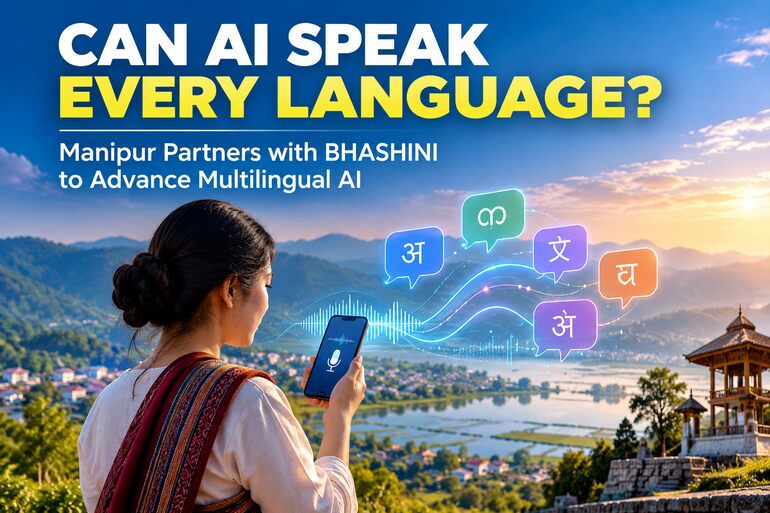
The Government of Manipur has signed a memorandum of understanding (MoU) with the Digital India BHASHINI Division to advance multilingual AI and strengthen language technology for digital governance. The agreement was signed during the BHASHINI Rajyam Workshop, Manipur Chapter, held in Imphal on 14th October 2026, with a focus on improving access to government and citizen-facing digital services through Indian-language technologies.
The workshop was organized by the Digital India BHASHINI Division (DIBD), under Digital India Corporation (DIC) and the Ministry of Electronics and Information Technology (MeitY), in collaboration with the Department of Information Technology, Government of Manipur. The discussions explored how multilingual artificial intelligence could help make digital services more accessible to people across the state’s linguistically diverse communities.
BHASHINI MoU to Strengthen Language Technology
The MoU establishes a framework for co-operation between DIBD and the Government of Manipur to strengthen language resources and explore multilingual digital service solutions. Amitabh Nag, Chief Executive Officer of DIBD and Somorjit Salam, Secretary of Information Technology, Government of Manipur represented the two organizations in signing the agreement.
As a next step, the parties will identify priority applications, assess language-data requirements and explore the integration of BHASHINI technologies into relevant government platforms. The collaboration will also involve language experts and local communities in developing and validating solutions suited to the state’s linguistic and public-service needs.
The initiative is intended to help bridge language barriers that can limit citizens’ ability to understand information and use online government services.
Also Read: Suyog Urja’s 100 MW Wind Project Adds Momentum to Enviro Infra
English-to-Manipuri AI Translation Demonstrated
A key highlight of the BHASHINI Rajyam Workshop was a live demonstration of real-time English-to-Manipuri translation. The demonstration illustrated how AI-powered language tools could support communication across languages and potentially improve access to digital information.
The workshop also examined BHASHINI’s Language-First Digital Public Infrastructure, which brings together language datasets, AI models, application programming interfaces (APIs) and applications to support multilingual services.
Discussions covered possible applications in areas such as education, healthcare, legal services and grievance redressal. These use cases could help government departments explore ways to make information and service interfaces easier for citizens to understand in their preferred languages.
Manipur’s Linguistic Diversity in Focus
The workshop highlighted the importance of developing language technologies that reflect the linguistic diversity of Manipur, including Manipuri, Tangkhul, Thadou, Paite, Hmar and Liangmai, among other languages spoken across the state.
Building useful multilingual AI systems requires relevant language data, local expertise and careful validation. Involving language specialists and communities can help ensure that digital tools better reflect local vocabulary, communication practices and real-world requirements.
The discussions also highlighted the role of community participation in strengthening language resources and improving the usefulness of AI-driven translation and other language applications.
Also Read: Chennai Ring Main Project Brings a New Water Infrastructure Vision
BHASHINI Rajyam and Inclusive Digital Governance
The BHASHINI Rajyam initiative seeks to strengthen collaboration between the Digital India BHASHINI Division and state governments to advance language technology and make digital services more inclusive.
For Manipur, the latest agreement creates an opportunity to explore how multilingual AI can support citizen-facing platforms and public administration. The next phase will focus on identifying practical applications, assessing data needs and evaluating how BHASHINI technologies could be incorporated into relevant government systems.
The initiative reflects a broader effort to make India’s digital ecosystem more accessible across languages. Its impact will depend on the development of suitable language resources, validation of technology and successful integration into services that citizens can use confidently.
Source: Ministry of Electronics and Information Technology, Government of India
