




Precise timekeeping depends on technologies capable of measuring the behaviour of atoms with extraordinary accuracy. Around the world, hundreds of atomic clocks are continuously compared to establish International Atomic Time (TAI), while Germany’s Physikalisch-Technische Bundesanstalt (PTB) contributes two advanced caesium fountain clocks, CSF1 and CSF2. These clocks use lasers to cool clouds of caesium atoms to temperatures of just a few microkelvin before carrying out highly precise measurements through Ramsey spectroscopy. In the latest setup, Arbitrary Waveform Generator (AWG) cards from Spectrum Instrumentation play a key role in controlling the laser frequencies used throughout the clock’s operating cycle. The CSF1 and CSF2 clocks also help steer UTC (PTB), which forms the basis of Germany’s legal time and supports a wide range of applications, from transportation and communications to broadcasting and computer systems.
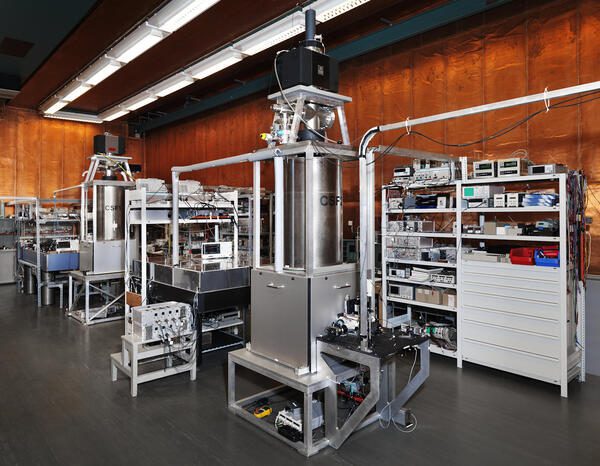
The operation of a caesium fountain clock is based on the quantum behaviour of caesium atoms. The international definition of one second is based on exactly 9,192,631,770 periods of radiation associated with the transition between two energy levels in the ground state of the caesium-133 atom. Inside the clock’s vacuum chamber, a cloud of ultracold caesium atoms is launched through a Ramsey microwave cavity. The atoms pass through the cavity twice, once as they travel upward and again as they fall under gravity. Their final state is then determined through laser-induced fluorescence spectroscopy, allowing the clock to precisely measure the caesium transition frequency.
Also Read: Eplan Platform 2027: What’s New in AI, Cloud Device Management and Integration
How to cool down the caesium atoms
Dr. Johannes Rahm, a member of PTB’s Time and Frequency department, explains: “Before the measurement can take place, a cloud of ultracold atoms must be loaded. This is realized by means of a magneto-optical trap (CSF1) or an optical molasses (CSF2). In both cases, lasers in specific geometric alignment are detuned slightly below an optical transition of caesium-133. Due to the residual thermal motion, this laser light is Doppler-shifted to the transition frequency and by absorption of photons from the laser and conservation of momentum, the atoms in the cloud are slowed and therefore cooled down.”
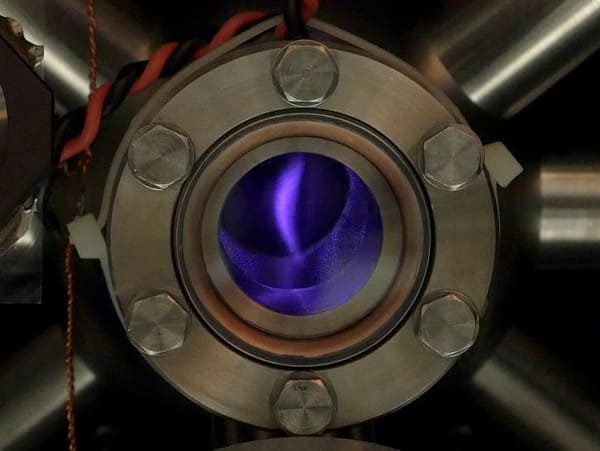
A working cycle of the caesium fountain clock
A small frequency difference between the lasers then pushes the cloud upward, like tossing a ball into the air. This creates the ‘fountain’ effect: the atoms pass through the Ramsey cavity once on the way up and again on the way down under gravity. After passing the Ramsey-cavity the second time, the transition probability is determined by means of fluorescence spectroscopy. During each passage of the Ramsey-cavity, a microwave pulse is applied. The frequency of this pulse is tuned so that the resulting transition probability is about 50%. With each fountain cycle, which consist of the loading phase, the launch phase, the Ramsey-interrogation, detection and ballistic flights in between the phases, the sign of the microwave frequency detuning is inversed, so that the left and the right side of the symmetrical transition probability structure is sampled. The true transition frequency is then given by the mean of the two steered frequencies set for the 50% transition probability. Once the measurement is complete, after about 1.2 seconds, the cycle starts again and continues 24 hours a day.
Also Read: SAR Testing Gets Smarter: MWF and Rohde & Schwarz Automate 5G Measurements
Evolution of the clocks
The caesium fountain clock requires careful control of the lasers. This was originally implemented by using custom analog circuitry developed by an earlier generation of PTB engineers and scientists. Maintaining such a complex system for the long term becomes increasingly difficult. So, like the experiment itself, the supporting electronics must evolve, leading Dr. Rahm to explore how to replace its analog system with a digital alternative.
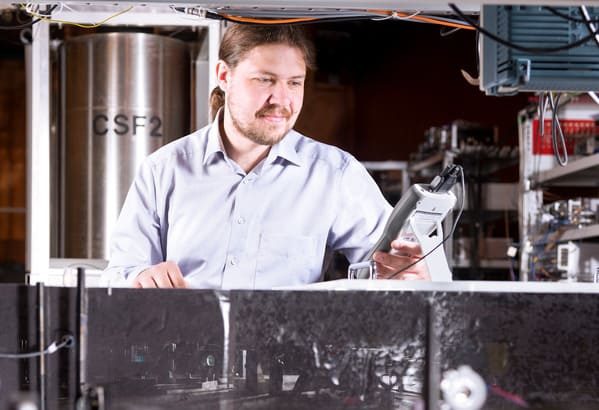
His research led him to integrate AWG (Arbitrary Waveform Generator) cards in PXIe format from Spectrum Instrumentation. These cards generate the RF frequencies required to manipulate the laser frequencies for cooling, launching and detection of the atoms using acoustic-optical modulators.
Fast reaction of the Spectrum support
However, a challenge arose during implementation. Although the M4x.6622-x4 AWG cards met the accuracy extremely well, none of the possible signal generation modes matched the special requirements needed at PTB. For an efficient design of the caesium fountain clock cycle, each laser needs a specific set of waveforms at a specific time of the cycle. Dr. Rahm contacted the Spectrum Instrumentation support, which is handled by the design engineers directly. In just two days, the software engineers developed a new feature called “Sequence Restart Mode”. Dr. Rahm’s tests were successful, and the new mode works exactly as envisioned.
Meanwhile, Spectrum Instrumentation released the Sequence Restart Mode as a free-of-charge upgrade for all AWGs in the 65xx and 66xx series. The new mode can be enabled easily by installing the latest drivers.

1 Comment
Pingback: Agrizy Makes Strong Miami Debut