



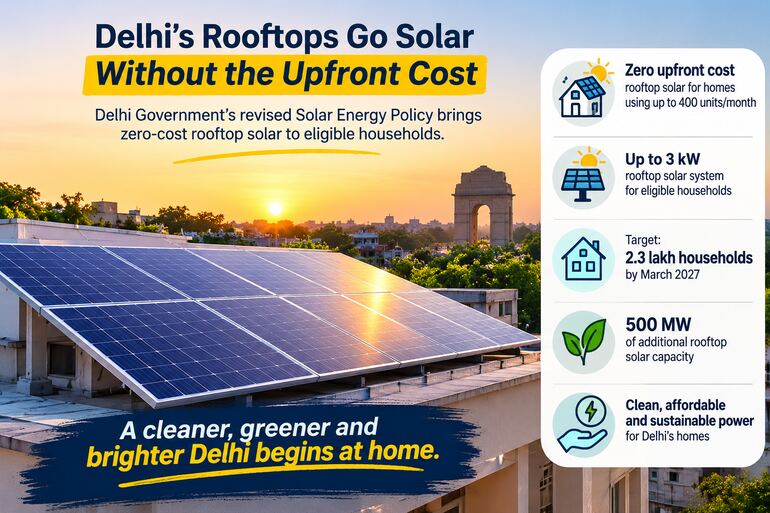
The Delhi Cabinet has approved the second amendment to the Delhi Solar Energy Policy 2023, introducing a zero-cost rooftop solar system for eligible households under the revised policy in 2026. Under the amended policy, eligible households consuming up to 400 units of electricity a month can install rooftop solar systems of up to 3 kW without making any upfront payment, giving a major boost to residential rooftop solar adoption across Delhi.
Hon’ble Chief Minister of Delhi Smt. Rekha Gupta announced the revised policy as part of the Delhi government’s effort to accelerate the adoption of rooftop solar and make clean energy more accessible to households. The government has set an ambitious target of installing rooftop solar systems across 2.3 lakh households by March 2027, with the programme expected to add around 500 MW of rooftop solar capacity across Delhi.
Zero upfront cost for eligible households
Under the revized Delhi Solar Energy Policy, domestic consumers with average monthly electricity consumption of up to 400 units will be eligible for rooftop solar systems of up to 3 kW, subject to applicable technical conditions. The key change is aimed at removing one of the biggest barriers to rooftop solar adoption – the initial installation cost.
The Centre’s PM Surya Ghar Muft Bijli Yojana provides capital support of up to ₹78,000 for a 3 kW residential rooftop solar system. The Delhi government is adding its own capital subsidy of up to ₹78,000 for the 3 kW system, along with an additional top-up for eligible households to bridge the remaining installation cost.
For households in the 201-400 units monthly consumption category, the reported support for a 3 kW system comprises ₹78,000 from the Centre, ₹78,000 from the Delhi government and an additional ₹19,000 top-up, effectively covering the reported installation cost of around ₹1.75 lakh.
Also Read: Tamil Nadu’s New Industrial Map: Semiconductor, FinTech and Logistics Hubs
Solar savings and surplus power benefits
The revized framework is also designed to allow households to benefit from the electricity generated by their rooftop systems. For eligible households installing a 3 kW system, the government estimates that around 200 units of electricity could be saved through solar generation, while another 100 units could potentially be exported to the grid, depending on generation and consumption. For households consuming between 201 and 400 units a month, the estimated average additional monthly benefit from solar is around ₹1,659/-, according to details reported following the policy announcement.
The policy also retains the existing electricity subsidy framework. Households consuming up to 200 units will continue to receive the applicable electricity subsidy while gaining the additional benefits associated with rooftop solar.
Five years of maintenance support
The revized initiative also seeks to address another concern for households considering rooftop solar: maintenance after installation. The amended policy provides for five years of maintenance support for the systems installed under the programme, according to reports on the revized policy. This could further reduce the financial and operational barriers that have slowed residential rooftop solar adoption in the capital.
Also Read: Point S Equips Future Leaders to Manage Workshop Growth in a Changing Market
Delhi targets 2.3 lakh solar rooftops
The scale of the programme is one of its most significant features. The Delhi government aims to bring rooftop solar systems to approximately 2.3 lakh households by March 2027, while adding around 500 MW of rooftop solar capacity across the city.
The move builds on Delhi’s existing Solar Energy Policy, which was notified in March 2024 with the broader objective of expanding rooftop solar capacity in the capital. The Delhi government’s solar portal continues to provide routes for consumers to apply for rooftop solar under the PM Surya Ghar scheme and the Delhi Solar Energy Policy.
A stronger push for household solar adoption
The revized policy represents a shift from simply encouraging rooftop solar adoption to directly addressing the upfront cost faced by residential consumers. By combining central assistance, Delhi government support and additional funding for eligible households, the government is seeking to make rooftop solar a more accessible option for families with moderate electricity consumption.
The initiative also aligns Delhi’s residential clean energy push with the broader national PM Surya Ghar programme, which is designed to accelerate rooftop solar adoption among households.
With the government targeting 2.3 lakh installations in a relatively short period, the implementation of the revized policy, including consumer applications, vendor deployment, installation and maintenance will be critical to determining how quickly the programme translates into actual rooftop solar capacity.
