



The Government of India has outlined an ambitious roadmap for expanding energy storage infrastructure as it prepares the country’s power system for higher renewable energy integration and improved grid reliability.
According to information shared by the Ministry of Power, Hon’ble Minister of State for Power Shri Shripad Naik, in a written reply in the Rajya Sabha, the National Electricity Plan (Generation) projects significant growth in Battery Energy Storage Systems (BESS) and Pumped Storage Plants (PSPs) over the coming years to support India’s evolving electricity network.
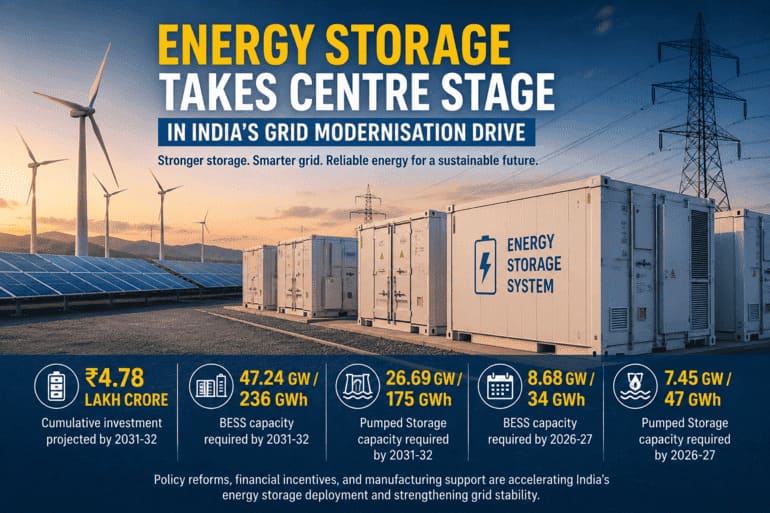
The National Electricity Plan estimates that India will require 47.24 GW/236 GWh of Battery Energy Storage Systems (BESS) and 26.69 GW/175 GWh of Pumped Storage Plants (PSPs) by 2031-32. The estimated investments required to achieve these capacities are approximately ₹3.49 lakh crores for BESS and ₹1.29 lakh crores for PSPs.
For the interim period, the plan projects a requirement of 8.68 GW/34 GWh of BESS and 7.45 GW/47 GWh of Pumped Storage Plants by 2026-27, highlighting the increasing role of energy storage in supporting India’s expanding renewable energy capacity.
Also Read: KSERC Clears KSEB’s 200 MW Solar-Plus-Storage Procurement
Energy Storage Identified as a Key Enabler
The Ministry of Power also referred to NITI Aayog’s Sectoral Insights: Power (Volume 7) report released in February 2026, which identifies energy storage as a critical requirement for managing the variability associated with renewable energy generation.
As India continues to increase the share of solar and wind power in its electricity mix, energy storage is expected to play an important role in balancing supply and demand, improving grid flexibility, supporting peak power requirements and enhancing overall system reliability.
Also Read: NTPC REL Invites Bids for 240 MW/960 MWh Battery Energy Storage System at Devikot, Rajasthan
Government Strengthens Policy and Regulatory Framework
The Ministry highlighted that the Government has introduced several policy and regulatory measures to accelerate the deployment of Energy Storage Systems across the country.
Among the key initiatives, the Electricity Rules were amended to formally recognize Energy Storage Systems as an integral part of the power sector, enabling their participation across generation, transmission and distribution. Energy Storage Systems have also been included in the Harmonised Master List of Infrastructure, improving access to long-term financing.
The Government has further incorporated energy storage into Resource Adequacy Planning Guidelines, issued a National Framework for Promotion of Energy Storage Systems, and notified new safety requirements and construction standards for Battery Energy Storage Systems through the Central Electricity Authority.
Measures to Encourage Storage Deployment
To improve project viability and encourage large-scale deployment, the Government has introduced several market development measures. These include Inter-State Transmission System (ISTS) charge waivers for eligible BESS and PSPs, participation of storage resources in ancillary services, tariff-based competitive bidding guidelines for procurement of storage projects, and Viability Gap Funding support for 43.8 GWh of BESS.
The Government has also enabled BESS to participate in the High-Price Day-Ahead Market, exempted certain closed-loop off-stream Pumped Storage Projects from requiring Central Electricity Authority concurrence, and encouraged cleaner backup power solutions through amendments to the Electricity (Rights of Consumers) Rules.
Also Read: Madhya Pradesh Invites Bids for 625 MW/1,250 MWh Standalone Battery Energy Storage System
Manufacturing Support Receives Additional Push
Alongside deployment initiatives, the Government is supporting domestic manufacturing of advanced battery technologies through the Production Linked Incentive (PLI) Scheme being implemented by the Ministry of Heavy Industries. The scheme has an outlay of ₹18,100 crores to establish 50 GWh of Advanced Chemistry Cell manufacturing capacity, including dedicated capacity for grid-scale stationary energy storage applications.
Additional measures include infrastructure support for hydro pumped storage projects, regulatory changes allowing consumers to develop, own, lease or operate energy storage systems, and an advisory encouraging co-location of energy storage with solar power projects to improve renewable energy dispatchability.
Supporting India’s Clean Energy Transition
The Ministry said these co-ordinated policy, regulatory, financial and manufacturing initiatives are intended to accelerate the deployment of energy storage infrastructure while strengthening grid flexibility and reliability.
With renewable energy capacity continuing to expand across the country, Battery Energy Storage Systems and Pumped Storage Plants are expected to play an increasingly important role in ensuring reliable electricity supply and supporting India’s long-term clean energy transition.
