



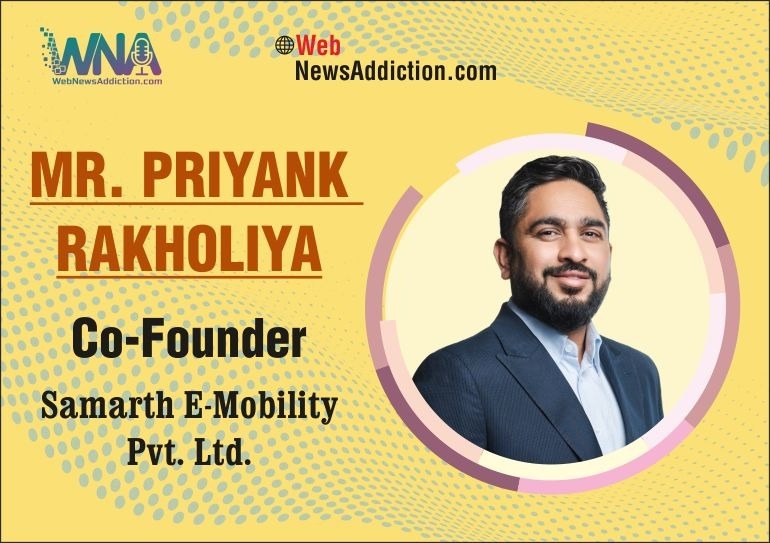
As India’s EV ecosystem moves towards a phase where technology depth matters as much as speed to market, Samarth E-Mobility is building its future around ownership of the complete technology stack. Over the last three years, the company has developed a fully indigenously owned full-stack platform within its own R&D Facility, covering the battery pack, battery management system (BMS), motor controller, power electronics, onboard charger, instrument cluster, and even its own operating system, with a clear focus on integration rather than assembly.
As Mr. Priyank Rakholiya, Co-Founder, Samarth E-Mobility Pvt. Ltd. points out, “Integration provides us with the opportunity to design the entire product as one system, rather than a mere aggregation of parts.”
This philosophy is closely tied to the company’s long-term vision of building an independent and indigenous EV ecosystem in India, where key systems such as the motor, battery management system, power electronics, and operating systems are developed internally. This enables tighter control over development, tuning, innovation, and supply-chain independence, while also allowing technologies to be tailored for Indian riding conditions. Moreover, this creates an AI enabled continuous learning model for vehicle telematics.
Also Read: https://webnewsaddiction.com/panitos-roboware-building-the-intelligence-beneath-indias-ev-future/
Translating In-House Engineering into Rider Benefits
For the rider, the biggest advantage of this full-stack approach is a more refined, reliable, and predictable experience. Since all key components are designed to work together seamlessly, the company can optimize energy efficiency, thermal management, and performance delivery much more effectively.
Its patented and homologated BMS, validated by ICAT, enables precise monitoring and advanced safety controls, while the battery pack has been tested and homologated by NATRAX, reinforcing product robustness. From a reliability standpoint, the platform has undergone over 51,000 km of real-world riding and more than 3,400 km of torture testing, ensuring durability across diverse Indian conditions.
Breaking the Traditional EV Trade-Offs
One of the most persistent engineering challenges in EVs is balancing performance, range, power, and efficiency, and Samarth’s approach is to reduce these compromises through tight software-hardware integration.
On the engineering side, Mr. Priyank Rakholiya adds, “We strive to reduce such trade-offs by having tight integrations between software and hardware.”
Because the company has total control over the EV stack, it can optimize interactions between subsystems, enabling high levels of performance without greatly sacrificing the vehicle’s usability and thermal management capabilities. This helps create a product experience that is both premium and highly practical.
Built for India’s Roads, Climate, and Usage Conditions
India’s operating environment remains one of the most demanding for electric mobility. Speaking about India’s unique mobility realities, Mr. Rakholiya observes, “India is a very challenging environment – extreme weather conditions, dust, rough terrains, and uncertain usage patterns.”
These realities have shaped the way Samarth designs and validates its EV systems. The products have been tested extensively in real roads, dynamometer validation, and rigorous endurance cycles, ensuring that the systems remain thermally stable, mechanically strong, and dependable across urban stop-and-go traffic as well as longer drives. Since the research and development is based in Gujarat, the products are both made and tested in India.
The Next Chapter: Premium Electric Motorcycles
As Samarth prepares to launch its new range of high-performance electric motorcycles, the company is focusing on technology depth, performance, and integration. As Mr. Rakholiya highlights, the upcoming motorcycles will be powered by a fully indigenous platform with seamless hardware-software integration, while the roadmap also includes innovations such as rare-earth-free motor technology and an AI-controlled onboard fast charger, unique battery pack assembly & BMS. The company is particularly focused on the premium, aspirational segment, positioning these motorcycles as an alternative to 100cc – 200cc ICE motorcycles.
What Will Define Long-Term EV Leaders
As the EV sector enters a phase of consolidation, long-term differentiation is expected to come from core engineering capability and technology ownership. Looking at the sector’s next phase, Mr. Rakholiya believes, “Companies that will succeed for the long term will be those that have solid engineering fundamentals, control of their core technology, verified products, and scalable business models.”
This reflects a broader industry shift where capability is becoming more important than rapid market entry, especially for companies aiming to build long-term trust, product credibility, and manufacturing scale.
Contributing to India’s Clean Mobility Future
Looking ahead, Samarth’s vision is to play its part in creating an independent and technology-based EV landscape in India. With an advanced manufacturing plant that has over 1,50,000+ sq. ft. of manufacturing space and the ability to manufacture more than 45,000 units per month, the company is laying down a platform for significant impact. At the same time, its goal is to enhance indigenous technology, reduce dependence on imports, and manufacture high-end electric scooters, while contributing towards India’s objective of cleaner mobility.
Samarth’s journey reflects a larger shift taking shape within India’s EV sector, where the next phase of growth will increasingly be defined by deep engineering ownership, validated performance, and the ability to build for Indian realities at scale. In that transition, the company’s full-stack approach positions it as part of a new generation of EV players focused not just on product launches, but on building long-term technology foundations for cleaner mobility.
