



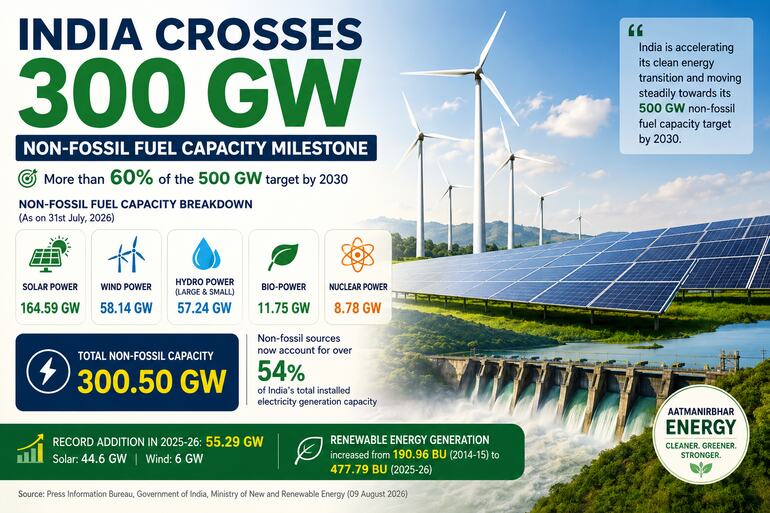
India has crossed a major clean-energy milestone, with its installed non-fossil electricity generation capacity reaching 300.50 GW as of 31st July, 2026. The achievement puts the country more than 60% of the way towards its target of 500 GW of non-fossil capacity by 2030 and highlights the accelerating role of renewable energy in India’s power sector.
According to data released by the Government of India, non-fossil sources now account for more than 54% of the country’s total installed electricity generation capacity, which stands at around 552 GW. The milestone reflects rapid growth across solar, wind, hydropower and other low-carbon sources, alongside continued investment in nuclear generation and domestic clean-energy manufacturing.
India’s non-fossil capacity at a glance:
- Solar Power: 164.59 GW
- Wind Power: 58.14 GW
- Hydro Power (Large & Small): 57.24 GW
- Bio-power: 11.75 GW
- Nuclear Power: 8.78 GW
Total Non-Fossil Capacity: 300.50 GW
Solar remains India’s largest non-fossil power source
Solar power continues to account for the largest share of India’s non-fossil capacity, reaching 164.59 GW as of 31st July, 2026. The expansion has been particularly significant over the past decade. India’s solar capacity has grown from just 2.8 GW in 2014 to around 165 GW today, making solar the principal driver of the country’s renewable-energy capacity growth.
The rapid expansion has been supported by government policies aimed at increasing renewable-energy deployment while strengthening domestic manufacturing capabilities.
Wind power crosses 58 GW
India’s wind sector has also continued its upward trajectory, with installed wind power capacity reaching 58.14 GW. Wind capacity has increased substantially from around 21 GW in 2014, reflecting the growing contribution of wind energy to India’s electricity mix. With wind farms operating across several parts of the country and continued development of wind-energy infrastructure, the sector remains an important component of India’s strategy to expand non-fossil electricity generation.
The continued expansion of renewable energy is also increasing demand for technologies and components that help ensure the safe, reliable and efficient operation of wind turbines.
Also Read: Sarla Aviation Turns to Siemens Xcelerator to Accelerate eVTOL Development
Hydro and other non-fossil sources add to capacity
Hydropower remains another major contributor to India’s non-fossil generation portfolio. Large and small hydro projects together account for 57.24 GW of installed capacity.
Bio-power contributes another 11.75 GW, while nuclear power accounts for 8.78 GW. Together with solar and wind, these sources bring India’s total installed non-fossil capacity to 300.50 GW.
Record 55.29 GW added in 2025-26
The pace of capacity addition has also accelerated. During 2025-26, India added a record 55.29 GW of non-fossil-fuel-based electricity generation capacity. Solar accounted for 44.6 GW of the additions, while wind contributed another 6 GW.
The figures indicate the scale at which India’s power-generation landscape is changing as the country works towards its 2030 non-fossil capacity objective.
Renewable electricity generation continues to rise
The expansion is not limited to installed capacity. India’s renewable electricity generation has also increased significantly. Renewable-energy generation rose from 190.96 billion units in 2014-15 to 477.79 billion units in 2025-26, according to the Government of India.
This increase points to the growing contribution of renewable sources to India’s electricity supply and reflects the country’s broader shift toward a more diversified generation mix.
Also Read: Apraava Energy Secures Major Transmission Project to Power Andhra Pradesh’s Renewable Future
Domestic manufacturing strengthens clean-energy ambitions
India’s clean-energy expansion is being accompanied by efforts to develop domestic manufacturing capabilities.
One notable development is the growth of manufacturing capacity listed under the Approved List of Models and Manufacturers (ALMM) for Solar PV Modules. The enlisted capacity has crossed 200 GW, compared with just 2.3 GW in 2014. Government initiatives, including the Production Linked Incentive (PLI) scheme, are intended to support high-efficiency, domestically manufactured solar modules and strengthen supply-chain resilience.
The development is significant not only for renewable-energy deployment but also for India’s broader ambition to build a more self-reliant energy ecosystem.
Green hydrogen adds another dimension
India’s clean-energy strategy is also extending beyond electricity generation. Through the National Green Hydrogen Mission, the Ministry of New and Renewable Energy is working to develop India’s capabilities in the production, use and export of green hydrogen and its derivatives.
Green hydrogen could become an important element of the country’s longer-term decarbonization strategy, particularly in sectors where direct electrification is more challenging.
India moves closer to its 500 GW target
Reaching 300.50 GW of non-fossil capacity represents a significant step towards India’s goal of installing 500 GW of non-fossil electricity generation capacity by 2030.
With more than 60% of the target already achieved, the next phase will require continued investment in renewable generation, grid infrastructure, energy storage, domestic manufacturing and supporting technologies. The latest milestone also demonstrates how India’s energy transition is increasingly connected with industrial development, energy security and domestic manufacturing, rather than being driven solely by climate objectives.
As solar and wind capacity continue to expand, the focus will increasingly shift towards integrating larger volumes of renewable electricity into the grid while ensuring reliability, efficiency and resilience across the energy system.

1 Comment
Pingback: Hitachi Vantara Charts Road to Net Zero