



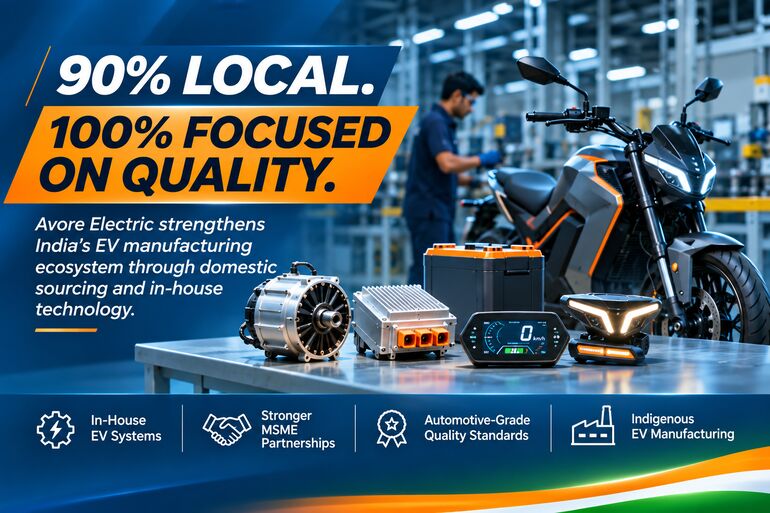
Avore Electric, India’s homegrown, technology-first electric motorcycle manufacturer from the Samarth E-Mobility group sources approximately 90% of its components domestically, underscoring its commitment to strengthening local manufacturing and minimizing reliance on imports. This strategy is backed by the company’s in-house capabilities in developing and manufacturing key EV systems, including motor controllers, digital instrument displays, battery packs, motors and position lamps.
The company has established in-house production capabilities for several critical components, including motor controllers, digital displays, battery packs and rare-earth-free motors. It also manufactures its signature tank lights and position lamps at its own facility. By developing these systems internally, Avore Electric aims to exercise greater control over component quality, product development and system integration, while contributing to the growth of India’s indigenous electric vehicle manufacturing ecosystem.
A key part of this localization strategy has been the development of a reliable domestic supplier network, particularly among Micro, Small and Medium Enterprises (MSMEs). Although several local suppliers had the required machinery and manufacturing infrastructure, meeting the stringent precision, consistency and process-control standards of the automotive industry required additional technical support and collaboration.
To bridge this gap, Avore Electric deployed its engineering and quality assurance teams at vendor facilities to strengthen production processes and bring manufacturing practices in line with automotive industry requirements. The company also implemented Advanced Product Quality Planning (APQP) and Production Part Approval Process (PPAP), ensuring that components undergo rigorous design, engineering and tolerance validation before being cleared for mass production.
Quality assurance remains central to Avore Electric’s manufacturing operations. Its production facility follows quality management practices aligned with IATF 16949 and ISO 9001 standards. These include Failure Mode and Effects Analysis (FMEA) during product design, Statistical Process Control (SPC) for monitoring manufacturing variations and Poka-yoke mechanisms to minimize errors during assembly. The company also maintains comprehensive traceability across components, sub-assemblies and software versions, covering every stage from raw material procurement and manufacturing to after-sales service.
Also Read: India’s Electricity Reset: The Big Shift Towards Batteries, Smarter Tariffs and Flexible Power
Mr. Priyank Rakholiya, Co-founder, Samarth E-Mobility said: “At Avore Electric, our commitment to customer-centric innovation, advanced technology, and global quality and safety benchmarks is reflected in our local sourcing strategy. Our first principles methodology of building a supply chain that meets these standards across Gujarat and other parts of India has required significant collaboration with our vendor partners and may have extended our rollout timelines since our August 2026 launch. However, this disciplined approach ensures complete oversight and confidence in every component we source. For us, quality is non-negotiable, and we would rather delay deliveries than bring a product to market that falls short of our standards.”
Avore Electric’s in-house testing capabilities further support manufacturing quality and consistency. The battery production line incorporates automated cell grading, sorting, laser marking, wire bonding and charge-discharge cycle testing. Similarly, the motor production line uses controlled thermal processes, precision bearing assembly and dedicated dynamometer testing before integration into the motorcycle.
Also Read: Your Car Is Getting Smarter. But Who Is Guarding It Against Cyber Threats?
Through domestic sourcing, in-house component manufacturing and closer collaboration with Indian suppliers, Avore Electric aims to reduce import dependence while contributing to the development of India’s indigenous electric mobility manufacturing ecosystem.
