



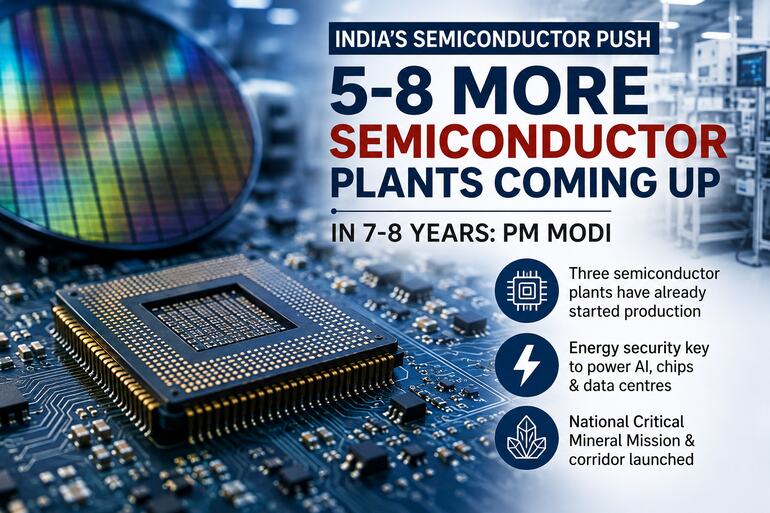
Prime Minister Shri Narendra Modi has placed semiconductors, critical minerals and energy security at the centre of India’s technology and self-reliance strategy, announcing that another five to eight semiconductor plants are expected to come up over the next seven to eight years.
Addressing the nation from the Red Fort on India’s 80th Independence Day, the Prime Minister said three semiconductor plants had already started production and India had begun exporting chips, presenting the development as an important step towards building domestic technological capabilities.
The Prime Minister linked the semiconductor push to a broader effort to reduce India’s dependence on other countries for critical technologies, resources and energy. He said India could not become a developed country by remaining dependent on other nations and stressed the need to build domestic capabilities under the broader vision of an Aatmanirbhar Bharat.
India’s Semiconductor Push
Semiconductors featured prominently in Prime Minister Modi’s argument for greater technological self-reliance. He noted that semiconductor technology has become essential across a wide range of industries, including electronics, medical equipment and transportation. The government has been seeking to establish a complete semiconductor ecosystem in India, covering manufacturing as well as other parts of the chip supply chain.
According to the Prime Minister’s Office, India previously had no major semiconductor manufacturing plant, while a domestic semiconductor ecosystem is now being developed and three plants have been initiated. India has also started exporting chips.
Prime Minister said the country would see further expansion in semiconductor manufacturing, with five to eight additional plants expected to start over the next seven to eight years. The announcement adds another layer to India’s efforts to strengthen its position in global technology and manufacturing supply chains.
Also Read: “Made in India” Isn’t Enough: From Wheels to Code, Priyank Rakholiya on Building the Indian EV
Chips Need Critical Minerals And Energy
Prime Minister Modi’s speech went beyond semiconductor manufacturing itself, linking chips with two other strategic requirements, namely critical minerals and energy. He said modern technology is dependent on critical minerals and highlighted the government’s efforts to strengthen India’s position in the sector.
The Prime Minister referred to the National Critical Mineral Mission and the critical minerals corridor announced by the government, while also pointing to agreements being pursued with other countries. The government has identified critical minerals as strategically important for emerging technologies and manufacturing, making access to reliable supplies an increasingly important part of India’s industrial strategy.
Energy, meanwhile, was presented as another essential foundation for India’s technology ambitions. The Prime Minister stated that the growing use of semiconductors, artificial intelligence and data centres would require large quantities of electricity, making energy security a key requirement for the country’s future growth.
Nuclear Power Gets A Major Target
As part of the energy-security push, the Prime Minister has set a target of taking India’s nuclear power capacity to 100 GW by 2047. He also announced plans to start five new nuclear reactors during the current decade and highlighted India’s progress in fast-breeder nuclear technology.
The nuclear expansion is intended to form part of a wider strategy to ensure that India’s rapidly growing economy has access to reliable energy. The Prime Minister also highlighted developments in solar energy, railway electrification and hydrogen technology as part of India’s changing energy landscape.
From Self-Reliance To Viksit Bharat
The semiconductor, critical-mineral and energy announcements form part of Prime Minister Modi’s larger vision of transforming India into a developed country by 2047. The Prime Minister said self-reliance should not mean simply obtaining products cheaply or quickly from abroad, but developing the domestic capability to produce strategically important goods and technologies.
He cited the “Make in India”, “Swadeshi” and “local for local” approaches as part of this effort. The government has also pointed to rapid growth in electronics manufacturing as evidence of India’s expanding industrial capabilities. The PMO says electronics manufacturing has increased nearly sevenfold over the last 12 years.
The semiconductor push is therefore being positioned not simply as a technology initiative but as part of a larger industrial strategy involving manufacturing, energy, minerals, innovation and global supply chains.
Also Read: Ashok Leyland and Drivn Join Forces to Make Electric Trucks Easier to Own
Why India’s Chip Ambitions Go Beyond Manufacturing
Semiconductors are increasingly central to modern economies, powering smartphones, automobiles, medical equipment, telecommunications infrastructure, computers and artificial-intelligence systems.
For India, developing domestic chip manufacturing could help reduce exposure to disruptions in global supply chains while creating opportunities for investment, electronics manufacturing and high-skilled employment. The expansion of semiconductor capacity is also taking place against a backdrop of rapidly rising demand for computing infrastructure. AI systems and data centres require both advanced chips and substantial amounts of electricity, making the connection between technology and energy increasingly important.
India’s semiconductor strategy consequently involves more than building fabrication and packaging facilities. It also requires reliable supplies of critical minerals, skilled workers, infrastructure, technology and energy.
The Prime Minister’s Independence Day message brought these strands together under the broader objective of building an economically and technologically self-reliant India. With three semiconductor plants already initiated and five to eight more expected over the next seven to eight years, the government is seeking to move India’s chip ambitions from policy planning towards a larger domestic manufacturing ecosystem.
The semiconductor expansion, alongside the push for critical minerals and greater energy security is expected to remain a key component of India’s strategy as it works towards its Viksit Bharat 2047 goal.
Source: Prime Minister Shri Narendra Modi’s Independence Day address; Government of India/Prime Minister’s Office
