



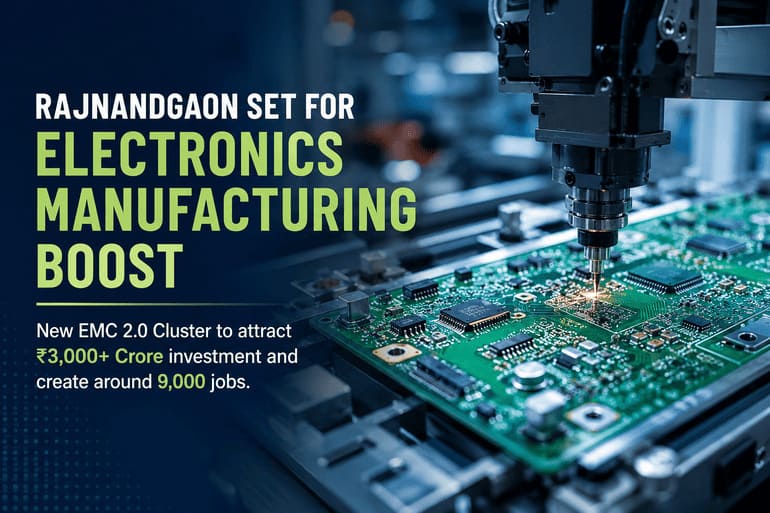
Rajnandgaon is stepping onto India’s growing electronics manufacturing map, with the Centre approving a new Electronics Manufacturing Cluster under the Modified Electronics Manufacturing Clusters 2.0 scheme. The project is expected to attract more than ₹3,000 crores in investment and generate nearly 9,000 direct and indirect employment opportunities, according to officials. The approval brings Rajnandgaon into greater focus as Chhattisgarh looks to strengthen its position in high-tech manufacturing.
The Ministry of Electronics and Information Technology (MeitY) has approved ₹210.56 crores in central financial assistance for the project, against an estimated project cost of ₹432.08 crores.
Rajnandgaon Emerges as a New Electronics Manufacturing Location
The proposed cluster is being developed under EMC 2.0, a government programme aimed at creating world-class infrastructure and common facilities for electronics manufacturing companies.
The scheme is intended to address infrastructure constraints faced by the electronics industry by providing facilities such as ready-built factory sheds, plug-and-play infrastructure and common amenities. MeitY says the programme is designed to attract major electronics manufacturers and their supply chains while improving supply-chain responsiveness and reducing logistics costs. For Chhattisgarh, the Rajnandgaon project could add another manufacturing location to the state’s efforts to expand beyond its traditional industrial base.
The state’s industrial policy has identified electronics hardware manufacturing among the sectors eligible for enhanced investment incentives, reflecting a broader push to attract technology-oriented industries and increase value addition within the state.
Also Read: India’s Renewable Energy Push Puts Green Energy Corridor at the Heart of Grid Expansion
Beyond ₹3,000 Crore, the Bigger Opportunity Is the Ecosystem
The headline investment potential is significant, but the larger opportunity could lie in the ecosystem that develops around the cluster. Electronics manufacturing rarely operates as an isolated activity. Large manufacturers require networks of component suppliers, assembly companies, logistics providers, testing facilities and other supporting businesses.
This is one of the central objectives behind EMC 2.0. The government describes the scheme as a way to strengthen the electronics manufacturing ecosystem by creating shared infrastructure and facilities that can attract both domestic and global manufacturers. For Rajnandgaon, the expected investment could therefore create opportunities beyond the companies that eventually establish facilities inside the cluster.
A stronger local manufacturing base could support supplier networks and create demand for skilled workers across production, engineering, quality control, logistics and other industrial functions. The expected 9,000 direct and indirect employment opportunities also underline the potential economic impact of the project.
Chhattisgarh Looks to Strengthen Its Electronics Footprint
The Rajnandgaon approval comes as India continues to expand its electronics manufacturing infrastructure across multiple states. MeitY’s wider EMC 2.0 programme has already approved projects and common facility centres across several parts of the country. In December 2025, the government said approved EMC 2.0 projects across 10 states had projected investment of more than ₹1.46 lakh crores, with around 1.80 lakh jobs expected.
Against this national backdrop, the Rajnandgaon project gives Chhattisgarh an opportunity to participate more actively in India’s growing electronics manufacturing ecosystem. The project also reflects the broader shift in India’s manufacturing strategy from simply assembling finished products towards developing stronger domestic ecosystems and supply chains.
A New Test for India’s Regional Electronics Manufacturing Push
The real impact of the Rajnandgaon Electronics Cluster will ultimately depend on how quickly infrastructure translates into actual manufacturing activity. Attracting anchor companies will be important, but so will bringing component suppliers, technology businesses and supporting industries into the ecosystem. The availability of reliable infrastructure skilled manpower and efficient logistics will influence how successfully the cluster can compete with established electronics manufacturing destinations.
Also Read: Pace Digitek Q1 Revenue Jumps 51.3% as BESS Capacity Reaches 5 GWh
The Centre’s approval provides the project with an important starting point. With ₹210.56 crores in central assistance, an estimated project cost of ₹432.08 crores, more than ₹3,000 crores in expected investment and around 9,000 employment opportunities, Rajnandgaon is now positioned to become another node in India’s expanding electronics manufacturing network.
For Chhattisgarh, the project represents more than a new industrial cluster. It is an opportunity to build a deeper electronics ecosystem and capture a larger share of India’s technology-led manufacturing growth.
Source: Ministry of Electronics and Information Technology (MeitY), Government of India
