



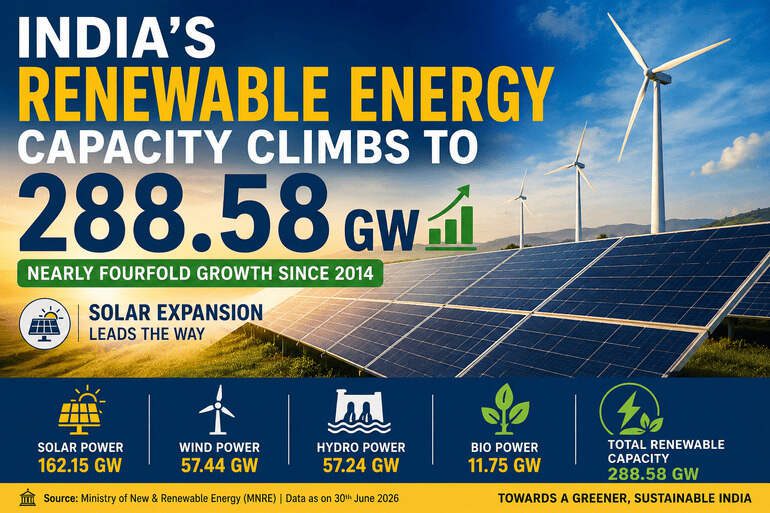
India’s transition towards clean energy has reached another important milestone, with the country’s installed renewable energy capacity touching 288.58 GW as of June 30, 2026. The latest figures released by the Ministry of New and Renewable Energy (MNRE) show that renewable energy capacity has grown nearly fourfold from 76.38 GW in 2014, reflecting the country’s sustained investment in clean power generation over the past decade.
The expansion has been driven by rapid growth in solar energy, steady additions in wind power, continued hydroelectric development, and increasing deployment of bioenergy projects. The latest numbers also underline India’s commitment to strengthening its energy security while reducing dependence on fossil fuels.
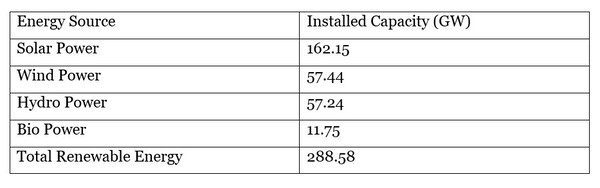
Renewable Energy Installed Capacity (as of June 30, 2026)
The balanced contribution from multiple renewable technologies strengthens the resilience of India’s electricity system while supporting long-term sustainability goals.
Also Read: https://webnewsaddiction.com/viviana-power-energizes-400kv-lilo-line-gujarat-wind-project/
Key Highlights
- Renewable energy capacity increased from 76.38 GW in 2014 to 288.58 GW in June 2026.
- Solar power accounts for the largest share with 162.15 GW of installed capacity.
- Total non-fossil fuel electricity capacity has reached 297.36 GW.
- The renewable energy sector attracted USD 45.72 billion in FDI between FY2014 and FY2026.
- Domestic financial institutions deployed approximately ₹12.32 lakh crore into renewable energy projects during the same period.
- Solar, wind, hydro, and bioenergy continue to drive India’s clean energy transition.
Solar Power Emerges as India’s Largest Renewable Energy Source
Solar energy continues to dominate India’s renewable energy landscape. With an installed capacity of 162.15 GW, solar power now accounts for more than half of the country’s total renewable energy capacity. Large-scale solar parks, rooftop solar installations, government-backed incentive schemes, and falling technology costs have all contributed to the sector’s rapid expansion.
Wind energy remains the second-largest renewable energy source with 57.44 GW of installed capacity, followed closely by 57.24 GW of hydroelectric power. Bio power contributes another 11.75 GW, helping diversify India’s renewable energy mix.
Total Non-Fossil Fuel Capacity Reaches 297.36 GW
When nuclear power is included, India’s total installed non-fossil fuel-based electricity capacity has reached 297.36 GW.
This includes:
- Renewable Energy: 288.58 GW
- Nuclear Power: 8.78 GW
The milestone demonstrates India’s steady progress towards increasing the share of clean energy in its electricity generation portfolio. Growing non-fossil fuel capacity is expected to play a crucial role in meeting rising electricity demand while supporting the country’s climate commitments and reducing greenhouse gas emissions.
Investments Continue to Fuel Renewable Energy Growth
India’s renewable energy expansion has been supported by substantial domestic and international investments. According to the government, the sector attracted approximately USD 45.72 billion in Foreign Direct Investment (FDI) between FY 2014 and FY 2026. At the same time, domestic financial institutions deployed nearly ₹12.32 lakh crore into renewable energy projects across the country.
Major financing institutions supporting the sector include:
- Indian Renewable Energy Development Agency (IREDA)
- Power Finance Corporation (PFC)
- REC Limited
- India Infrastructure Finance Company Limited (IIFCL)
- National Bank for Financing Infrastructure and Development (NaBFID)
- Small Industries Development Bank of India (SIDBI)
- Public sector banks
The continued flow of capital has enabled the development of large renewable energy parks, transmission infrastructure, hybrid projects, battery storage initiatives, and distributed renewable energy systems.
A Decade of Rapid Renewable Energy Expansion
India’s renewable energy journey has accelerated significantly since 2014. Government initiatives such as competitive bidding for renewable projects, solar park development, improved transmission infrastructure, production-linked incentives for domestic manufacturing, and policies promoting renewable energy adoption have contributed to sustained capacity additions.
Declining equipment costs, increased private sector participation, and growing investor confidence have also played a key role in expanding renewable energy deployment across the country. The result has been one of the fastest-growing renewable energy markets globally, with solar power emerging as the primary driver of new capacity additions.
Renewable Energy Supports Energy Security and Economic Growth
The expansion of renewable energy offers benefits beyond reducing carbon emissions. Greater renewable energy capacity helps diversify India’s energy sources, reduce dependence on imported fossil fuels, improve long-term energy security, and create employment opportunities across manufacturing, construction, operations, and maintenance.
The sector has also encouraged investments in grid modernization, energy storage, smart transmission networks, and domestic manufacturing of solar modules and related equipment. As electricity demand continues to rise due to urbanization, industrialization, and digital infrastructure growth, renewable energy is expected to play an increasingly important role in meeting future power requirements.
India’s Clean Energy Ambitions Continue
India has set ambitious long-term clean energy goals, including expanding renewable energy deployment and increasing the share of non-fossil fuel electricity generation.
With renewable energy capacity now approaching the 300 GW mark, the country has established a strong foundation for future growth. Continued investments in grid infrastructure, energy storage, offshore wind, green hydrogen, and domestic manufacturing are expected to further strengthen the renewable energy ecosystem in the coming years.
Maintaining the current pace of renewable energy capacity addition will be important for supporting India’s long-term clean energy and climate objectives.
Government Shares Latest Figures in Parliament
The latest renewable energy statistics were shared by Union Minister of State for the Ministry of New and Renewable Energy, Shri Shripad Yesso Naik, in a written reply in the Rajya Sabha. The data highlights the significant progress made by India over the past decade in expanding renewable energy capacity and attracting investments into the clean energy sector.
India’s Renewable Energy Journey Gains Momentum
With renewable energy capacity nearing the 300 GW mark, India continues to strengthen its position as one of the world’s fastest-growing clean energy markets. Backed by sustained policy support, rising investments, and rapid solar expansion, the country is steadily advancing towards its long-term energy transition goals while enhancing energy security and supporting sustainable economic growth.
Source: Press Information Bureau (PIB), Ministry of New and Renewable Energy (MNRE), Government of India
