



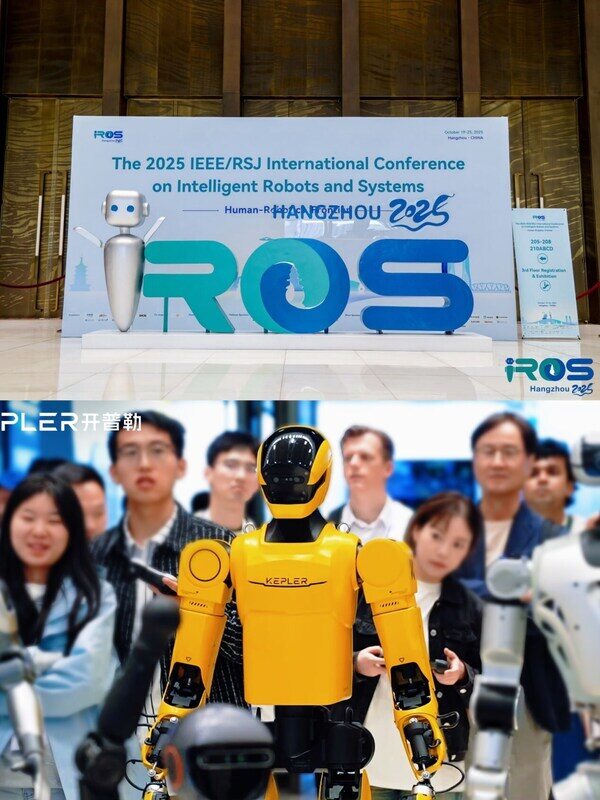
The 2025 IEEE/RSJ International Conference on Intelligent Robots and Systems (IROS 2025), one of the world’s foremost robotics events, took place in Hangzhou from October 19 to 25. Attracting more than 7,000 experts, researchers, and industry professionals globally, this year’s IROS was the largest in the conference’s history, gathering innovators to showcase cutting-edge robotics technologies. Shanghai Kepler Robot Co., Ltd. (“Kepler Robotics”) unveiled its latest humanoid robot, K2 “Bumblebee,” at IROS 2025, demonstrating breakthrough advances in humanoid robotics and launching its open developer ecosystem. The showcase highlighted the expanding influence of Chinese robotic technology on the international stage.
Demonstrating Technological Capabilities of Chinese Humanoid Robotics on the World Stage
The theme “Human-Robotics Frontier” guided IROS 2025 as leading firms from around the world exhibited next-generation solutions. At the Kepler Robotics booth, the K2 “Bumblebee” captured attention with remarkably fluid, humanlike walking, natural gestures like waving and a thumbs-up, and impressive performance in the robot parade, all consistently praised by attendees.
The superior capabilities of the K2 “Bumblebee” stem from a unique hybrid actuation system developed by Kepler’s engineering team, which integrates roller screw linear and rotary actuators. This system supports an authentic straight-knee gait while the proprietary planetary roller screw actuator delivers high torque density, precise control, and robust durability. In concert with rotary motors, the architecture ensures accurate joint movement and natural mobility.
In addition, the K2 “Bumblebee” successfully addresses the Sim-to-Real transfer challenge. Using reinforcement learning and GPU-accelerated physics simulation, thousands of robot models with varying parameters can be trained simultaneously across diverse scenarios to systematically refine locomotion control. Through imitation learning, a high-fidelity physics simulator enables the robot to replicate human walking behaviors with remarkable efficiency, condensing years of training data into hours. Reward-driven algorithms guide the robot to mimic human motion while optimizing for speed, energy efficiency, and balance. On site, Kepler Robotics showcased its Isaac Gym platform for large-scale parallel training and reinforcement learning, alongside the MuJoCo platform for physics-based simulation and feedback.
Kepler Robotics Launches One-Stop Developer Platform to Accelerate the Humanoid Ecosystem
As humanoid robots emerge as a key area for technological innovation, industry discussion increasingly centers on how to build and grow a sustainable ecosystem. Kepler Robotics emphasizes that progress in the field depends on open collaboration and knowledge exchange with the global developer community.
At the conference, Kepler Robotics introduced its developer platform, featuring tools for custom application development, including robotic arm control interfaces, motor APIs, and modules for vision, navigation, and voice. The platform is designed to support developers worldwide through four key components: Full-Stack Openness, an Integrated Perception-Decision-Control Toolbox, High-Fidelity Simulation & Digital Twin, and Modular Scene-Building Capability.
As part of its full-stack openness approach, Kepler Robotics has opened access to the core of its microkernel-based Nebula OS to developers and standardized software and hardware interfaces.
For system integration, the platform includes a built-in multimodal interaction engine that combines visual, auditory, and tactile data, giving developers out-of-the-box capabilities for perception and response.
In ultra-realistic simulation and digital twin applications, the Kepler Robotics Developer Platform delivers a physics-accurate virtual testing environment that enables “zero-risk” prototyping and “zero-cost” iteration. Code validated in simulation can be deployed to physical robots with one click, accelerating the path from concept to deployment.
For scene composition, within Kepler Studio, developers can assemble motion primitives using graphical drag-and-drop tools and natural language input, enabling rapid creation of complex task sequences and simplifying robot programming. A dedicated skill marketplace with shared resources will also be available to developers in future updates.
The Kepler Developer Platform directly addresses key developer considerations such as accessibility, security, and cost. It provides a full-spectrum toolchain, from intuitive visual interfaces to code-level control to support developers at every skill level. Multi-layered security frameworks help ensure safe and reliable operation throughout development and deployment. By combining efficient simulation with modular design, the platform reduces wear on hardware and shortens debugging cycles, allowing developers to focus more on innovation and real-world application.
To further drive ecosystem development, Kepler Robotics launched the Lighthouse Program, partnering with leading developers and industry collaborators to co-create solutions and accelerate commercialization. The initiative provides technical resources, market channels, and funding opportunities to help bring breakthrough concepts to market.
The IROS 2025 conference has drawn global robotics attention to China. Through its participation, Kepler Robotics gained fresh technical insights into potential industrial applications. More importantly, by bridging academia and industry, the company renewed its call for global developers to join its open ecosystem, reaffirming its commitment to driving innovation in humanoid robotics and expanding its real-world adoption.
