



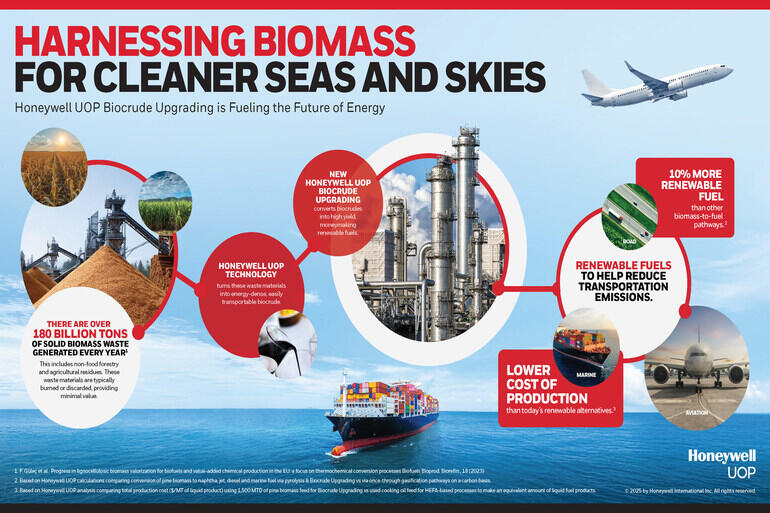
Honeywell has unveiled a groundbreaking technology that transforms agricultural and forestry waste into ready-to-use renewable fuels, targeting hard-to-decarbonize sectors like the maritime industry. This innovative process generates lower-carbon marine fuel, gasoline, and sustainable aviation fuel (SAF) from abundant and low-cost biomass sources such as wood chips and crop residues.
For ship operators, these drop-in fuels offer a cost-effective and environmentally friendly alternative to traditional heavy fuel oil. With a higher energy density than many existing biofuels, this renewable marine fuel can increase a vessel’s range without the need for expensive engine modifications.
“Honeywell continues to drive innovation in the areas that our customers need most,” said Ken West, President of Honeywell Energy and Sustainability Solutions. “The maritime industry has a real need for renewable fuels that are immediately available and cost effective. Our Biocrude Upgrading processing technology can be delivered in modular form, offering savings from the point of installation through to refining and use.”
Plant and agricultural waste can be converted into lower carbon biocrude at the feedstock collection sites, which keeps transport costs low. Honeywell’s new process technology enables biocrude to then be refined at major facilities to produce marine fuel, gasoline or SAF. This helps solve long-standing challenges with converting biocrudes into fuels with performance comparable to conventional fuel.
Biocrude Upgrading process technology can be delivered in the form of a prefabricated modular plant. As a result, Honeywell can help customers reduce risk and accelerate project timelines by simplifying site construction activity.
The introduction of Honeywell’s Biocrude Upgrading process technology comes as shipping companies seek to reduce their carbon footprints due to customer demands and regulatory drivers. Since the 1960s, heavy fuel oil—residual products from the refining of gasoline, diesel, and kerosene—has been the principal energy source for the maritime sector and a main source of its roughly 3% contribution of global greenhouse gas emissions.1
For more than a decade, Honeywell has provided process technologies for renewable and alternative fuels using various feedstocks. The new Biocrude Upgrading technology is complementary to its renewable fuels portfolio, which includes Ecofining, Ethanol to Jet technology, Fischer-Tropsch (FT) Unicracking technology and UOP eFining, a process that converts green hydrogen and carbon dioxide into e-fuels.
