



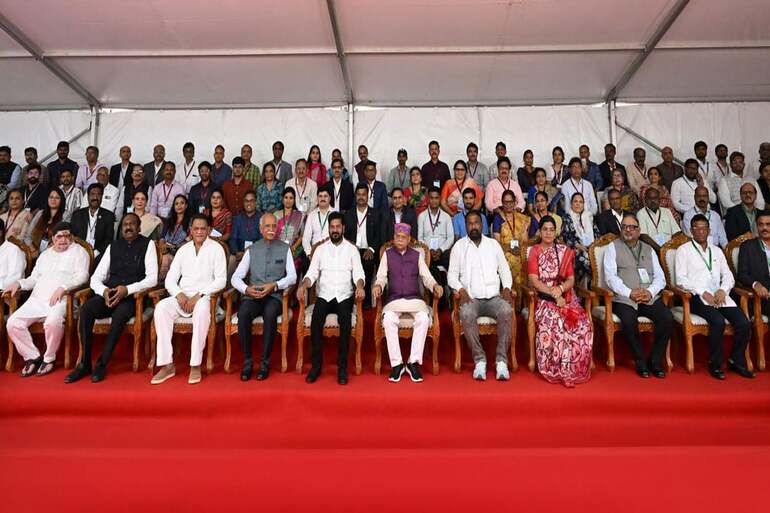
Cyient Foundation, the corporate social responsibility arm of Cyient Ltd. has launched a collaborative initiative with universities and government institutions in Telangana aimed at strengthening innovation, entrepreneurship, employability and future skills development across the state.
The initiative has been formalized through a series of Memorandums of Understanding (MoUs) signed with Osmania University, Kakatiya University, Jawaharlal Nehru Technological University Hyderabad (JNTUH), Palamuru University and Dr. B.R. Ambedkar Open University. The partnership also includes the Commissionerate of Collegiate Education (CCE) and the Commissionerate of Technical Education (CTE), Government of Telangana.
Designed to enhance collaboration between industry, academia and government, the programme will focus on fostering entrepreneurial thinking, strengthening faculty capabilities, promoting innovation-led ecosystems and expanding mentorship and employability opportunities for students and young professionals.
As part of the initiative, Cyient Foundation has proposed an investment of approximately ₹7.50 crores over three years, subject to regulatory approvals and implementation milestones. The long-term objective is to create a scalable framework that supports innovation, improves workforce readiness and contributes to Telangana’s socio-economic development.
“At the heart of India’s growth story lies the potential of its youth. To unlock this potential, we must create ecosystems that go beyond education—ones that inspire innovation, nurture entrepreneurship, and build real-world capabilities. This initiative reflects our belief that meaningful collaboration between government, academia, and industry can transform aspirations into opportunities. By empowering students, faculty, and communities across Telangana, we are not just creating skilled professionals—we are enabling future innovators, job creators, and nation-builders,” said, Dr. B. V. R. Mohan Reddy, Founder Chairman, Cyient.
Through its collaboration with CCE and CTE, the initiative will scale across approximately 152 Government Degree Colleges and 59 Government Polytechnics, extending access to industry exposure, skilling, and entrepreneurship opportunities across urban and rural regions.
A key focus area is future skills aligned to emerging industry needs, including Artificial Intelligence and Generative AI, data analytics, robotics and automation, IoT, drone technology, GIS and geospatial technologies, and Industry 4.0, along with cloud and certification-led learning pathways. Over the next three years, the initiative is expected to deliver measurable impact across employability, entrepreneurship, innovation, and rural livelihoods.
Under the Rural Skill Development Initiative, three centers at Palamuru University and Dr. B.R. Ambedkar Open University will be established in Narayanpet, Mahabubnagar, and Warangal. These centers will train 600 youth annually (2,000 over three years), with a focus on high-demand sectors such as healthcare, electronics manufacturing, and digital commerce. The program is designed to drive over 50% women participation and strong employment outcomes.
Complementing this, the Entrepreneurship Development Program (EDP) will reach over 4,000 students annually, with around 400 undergoing structured training, leading to 200 business ideas and 40 startup teams each year.
To further strengthen the innovation ecosystem, the initiative will support 20–25 startups annually through incubation and mentorship, with 5–10 progressing toward commercialization. It will also build institutional capacity by training over 200 faculty members and engaging 50+ industry experts as mentors.
Together, these interventions will create a strong pipeline of skilled professionals, entrepreneurs, and innovators, positioning Telangana’s higher education ecosystem as a driver of inclusive growth and innovation-led development.
Collectively, these interventions are expected to create a robust pipeline of skilled professionals, entrepreneurs, innovators, and job creators, positioning Telangana’s higher education institutions as engines of inclusive growth, economic development, and innovation-led nation building.
Building on its strong track record, Cyient Foundation has successfully digitized over 120 government schools, reaching more than 35,000 students with digital literacy. Through its Adopt-a-School initiative, over 21,000 children are currently receiving quality education. Beyond education, the Foundation has also championed women’s empowerment and rural development. Each year, more than 2,000 rural women are trained for sustainable employment.
