



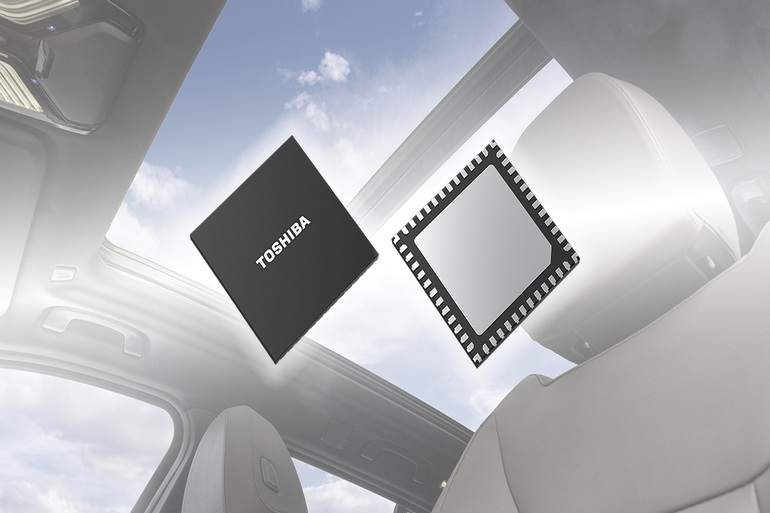
Toshiba Electronic Devices & Storage Corporation (“Toshiba”) has begun sample shipments of the TB9M001FTG, the second product in its Smart Motor Control Driver series, SmartMCD. This new device integrates a microcontroller featuring relay driver and LIN transceiver functions, enabling it to drive relays and control two brushed DC motors, making it ideal for a range of automotive applications.
In recent years, as the electrification of automotive equipment has progressed, secondary devices are increasingly required to offer higher performance, enhanced functionality, more compact designs, and fewer components. Toshiba has responded to these requirements, by developing the new product.
The new SmartMCD has four built-in low-side drivers that can be used for relay drivers and other applications, enabling forward and reverse control of two brushed DC motors. It also features a built-in microcontroller (Arm Cortex-M0 core), high-capacity flash memory, two high-side drivers for power-supply applications, a LIN transceiver, and a power supply system that can operate at the automotive battery level. All of these functions are integrated into a compact VQFN48 package (7×7 mm typ.).
In addition to controlling brushed DC motors in automotive applications, such as power sunroofs, electric wipers, power windows, and power seats, the driver is also capable of controlling various sensors and actuators. Furthermore, through LIN control from the main ECU, it can be utilized as a secondary device for a wide range of applications. This enables efficient control of various automotive functions and supports a broad spectrum of automotive applications.
Toshiba will continue to expand its lineup of SmartMCD series and will contribute to downsizing of automotive systems and reducing the number of components used.
Toshiba Electronic Devices & Storage Corporation, a leading supplier of advanced semiconductor and storage solutions, draws on over half a century of experience and innovation to offer customers and business partners outstanding discrete semiconductors, system LSIs and HDD products.
