



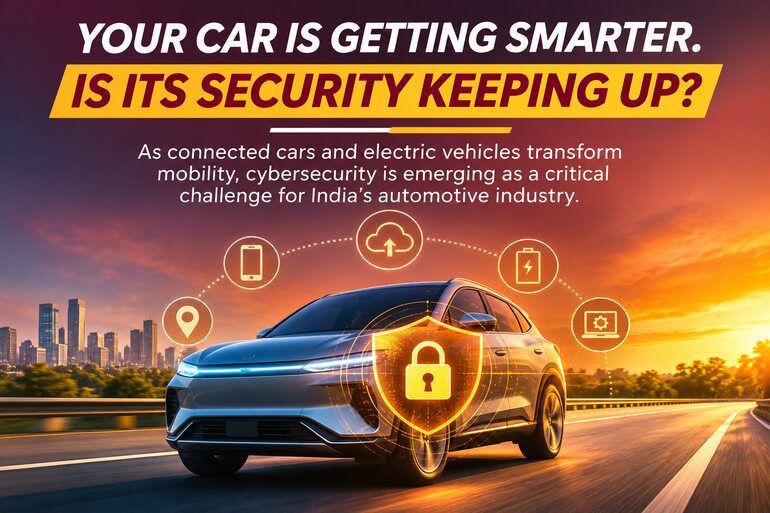
Your car can now do much more than take you from one destination to another. It can connect to your smartphone, track its location, monitor its battery, receive software updates and even communicate with other digital systems. But as vehicles become smarter, a new question deserves attention: who is protecting them from cyber threats?
Imagine a connected car whose digital systems are accessed without the owner’s knowledge, or an electric three-wheeler whose battery management system is exposed to unauthorized interference. These possibilities highlight why Vehicle Cybersecurity is emerging as a critical concern for India’s automotive industry. As manufacturers accelerate the shift towards electric, connected and software-driven vehicles, protecting these systems will be just as important as improving performance, efficiency and safety.
India’s automotive transformation is creating new opportunities, but it is also introducing risks that manufacturers, component suppliers and technology developers cannot afford to overlook. Vehicle cybersecurity is no longer just an IT concern. It is becoming an important part of vehicle safety, customer trust and the industry’s future readiness.
When Vehicle Technology Creates New Vulnerabilities
A modern vehicle is no longer just a mechanical machine. It contains multiple electronic control units (ECUs), sensors, communication networks and software systems that work together to manage everything from engine performance and braking to battery operation and infotainment.
Consider a connected car owner who uses a smartphone application to lock or unlock the vehicle, check its location or monitor its fuel level. These features make ownership more convenient, but they also mean that the vehicle is communicating with external digital platforms. Every connection needs to be properly secured.
The same applies to software updates. Manufacturers increasingly use over-the-air (OTA) technology to introduce improvements and fix software-related problems without requiring customers to visit a service centre. However, if the update process is not adequately protected, unauthorized software could potentially enter the vehicle’s systems.
The concern is not that every connected vehicle is vulnerable. Rather, the growing number of digital connections means manufacturers must identify and address potential weaknesses before they can be exploited.
India’s Electric Three-Wheeler Segment Offers an Important Warning
Vehicle cybersecurity is not limited to expensive connected cars or advanced autonomous vehicles. India’s electric three-wheeler segment has already highlighted how weaknesses in relatively simple electronic systems can create safety concerns.
In July 2026, the Ministry of Heavy Industries informed Parliament about vulnerabilities reported in certain battery management systems used in electric rickshaws. The systems reportedly had Bluetooth modules with default or no credentials, potentially allowing unauthorized individuals to access them through publicly available mobile applications.
Such access could allow changes to certain settings or interruptions to battery discharge, potentially causing a moving vehicle to shut down unexpectedly.
This example brings the cybersecurity discussion closer to everyday transport. Electric rickshaws are used to carry passengers and goods across Indian cities and towns. An unexpected interruption while a vehicle is moving could create risks for the driver, passengers and other road users.
The incident also highlights an important point: cybersecurity must be considered across all vehicle categories, including two-wheelers, three-wheelers, buses and commercial vehicles. As electrification expands, manufacturers cannot afford to treat digital security as an optional feature.
Where Can Cyber Threats Enter a Vehicle?
The growing complexity of vehicles means that cybersecurity risks can emerge across several systems. Some of the important areas deserve closer attention.
Connected vehicle applications: Smartphone applications allow owners to access vehicle information and perform selected functions remotely. Weak authentication, compromised accounts or inadequately protected communication channels could expose personal information or create opportunities for unauthorized access.
Battery management systems: In electric vehicles, the battery management system monitors temperature, voltage, current and other parameters to help maintain safe operating conditions. Its electronic communication interfaces need appropriate protection to prevent unauthorized interference.
Infotainment systems: Modern infotainment platforms connect vehicles with smartphones, navigation services and wireless networks. Manufacturers must ensure that these systems are appropriately separated from safety-critical vehicle functions.
Over-the-air updates: Software updates can improve vehicle performance and fix vulnerabilities. However, manufacturers must verify that updates come from trusted sources and cannot be modified during delivery or installation.
Advanced Driver Assistance Systems: ADAS technologies depend on cameras, radar, sensors and software to support features such as lane assistance, collision warnings and adaptive cruise control. Protecting the accuracy and integrity of the information used by these systems is essential.
These examples demonstrate why vehicle cybersecurity cannot be addressed through a single security measure. It requires protection across the vehicle’s electronic architecture, software, communication systems and external connections.
India’s Automotive Regulations Are Beginning to Address Cybersecurity
As vehicles become increasingly software-driven, cybersecurity is also finding a place in India’s automotive regulatory framework.
In June 2026, the Ministry of Road Transport and Highways published draft amendments to the Central Motor Vehicles Rules proposing requirements relating to vehicle cybersecurity and software update management.
Two important standards featured in the proposed framework:
AIS-189: Addresses vehicle cybersecurity and Cyber Security Management Systems (CSMS).
AIS-190: Addresses software updates and Software Update Management Systems (SUMS).
The proposed requirements aim to encourage manufacturers to identify cybersecurity risks, establish security management processes and ensure that software updates are implemented through controlled and secure procedures.
The real challenge begins after the vehicle rolls out of the factory. A vehicle may be secure when it leaves the factory, but its software will continue to evolve throughout its operating life. Manufacturers must therefore consider how vulnerabilities are identified, how security improvements are delivered and how updates are managed over time.
For example, if a manufacturer discovers a vulnerability in a connected vehicle system, it needs a reliable process to develop, validate and distribute a software fix. It must also ensure that the update reaches the intended vehicles without introducing new problems.
The proposed standards indicate that vehicle cybersecurity is becoming an important part of automotive compliance and product development. However, these provisions were published as draft amendments in June 2026 and should not be confused with final implemented requirements.
The Industry Needs a New Generation of Automotive Cybersecurity Professionals
One of the biggest challenges is the availability of people who understand both automotive engineering and digital security.
Traditionally, automotive engineers have focused on vehicle design, mechanical systems, electronics and performance. Cybersecurity professionals, on the other hand have concentrated on computer networks, software applications and information systems.
Connected vehicles increasingly require expertise that brings these disciplines together.
For instance, a professional working on an electric vehicle’s battery management system must understand how the battery operates, how its electronic components communicate and how those communication channels can be protected.
Similarly, someone working on connected vehicle software must understand not only programming but also the implications of a software vulnerability for the vehicle and its occupants.
This creates opportunities for specialized roles in automotive cybersecurity engineering, embedded software security, vehicle network testing, vulnerability assessment and secure software development.
Engineering colleges, ITIs and automotive training institutions will need to examine how their programmes can incorporate these emerging requirements. Industry-linked courses, practical laboratories and specialized training facilities could help bridge the gap between conventional automotive engineering and cybersecurity.
At the Automotive Skills Development Council’s Annual Conclave in 2026, vehicle cybersecurity was identified as an emerging skill requirement for India’s automotive workforce. This reinforces the need to prepare professionals for the changing technological demands of the sector.
Component Suppliers Must Become Part of the Cybersecurity Conversation
Vehicle manufacturers cannot address this challenge independently. Modern vehicles are built using components and software sourced from a large network of suppliers.
Electronic control units, telematics devices, sensors, battery management systems and infotainment platforms may come from different technology providers. Each component forms part of a larger vehicle architecture.
Consider a manufacturer sourcing its battery management system from one supplier and its telematics unit from another. Even if the manufacturer has strong internal cybersecurity practices, a weakness in a supplier’s component could potentially introduce a vulnerability into the overall vehicle system.
This makes cybersecurity a shared responsibility across the automotive supply chain.
Large manufacturers may have dedicated cybersecurity teams and testing infrastructure. Smaller component suppliers, particularly Tier-2 and Tier-3 companies may find it more difficult to access specialized expertise and invest in security testing.
OEMs will therefore need to work more closely with suppliers, establish clear cybersecurity expectations and encourage secure product development from the early stages.
India will also need stronger testing, validation and certification capabilities to help suppliers demonstrate that their products meet evolving security requirements.
The After-Sales Industry Cannot Be Left Behind
Another area that deserves attention is vehicle servicing and maintenance. As vehicles become more dependent on software and electronic systems, the nature of automotive repairs is changing. A technician may increasingly encounter problems that cannot be resolved through conventional mechanical troubleshooting.
Imagine a customer visiting a workshop because a connected vehicle application is behaving unusually or the vehicle is repeatedly losing communication with its remote monitoring system. The problem may not be a damaged physical component. It could involve software configuration, network communication or an authentication issue.
Similarly, technicians servicing electric vehicles need to understand the importance of secure access to battery management systems and authorized diagnostic procedures.
This does not mean every mechanic needs to become a cybersecurity specialist. However, technicians and service advisors should be able to recognize unusual system behaviour, follow secure diagnostic practices and escalate potential security incidents to qualified professionals.
Dealerships and independent workshops will need updated training, appropriate diagnostic equipment and clear procedures for handling software-related problems.
As a result, cybersecurity awareness may gradually become another important capability within the automotive after-sales ecosystem.
What Should India’s Automotive Industry Do Next?
Building a secure automotive ecosystem will require more than regulatory compliance. Manufacturers, suppliers, technology companies and training institutions must work together.
First, cybersecurity should be considered during vehicle design rather than added after development. Identifying vulnerabilities early can help manufacturers address problems before vehicles reach customers.
Second, component suppliers must be included in cybersecurity planning. OEMs should establish clear security expectations and encourage suppliers to adopt secure development and testing practices.
Third, India’s training ecosystem must evolve. Automotive engineering programmes should introduce practical exposure to embedded systems, vehicle networks, software security and cybersecurity testing.
Fourth, testing infrastructure needs to expand. Specialized facilities can help manufacturers and suppliers evaluate electronic components, connected systems and vehicle software under defined security requirements.
Finally, vehicle owners should also understand basic digital safety. Using strong passwords, protecting connected applications, installing authorized software updates and avoiding unverified third-party applications are simple steps that can reduce certain risks.
Cybersecurity cannot be the responsibility of one department or one company. It must become part of the industry’s wider approach to vehicle design, manufacturing, servicing and ownership.
The Next Automotive Revolution Must Be Secure
India’s automotive industry is moving towards a future defined by electric powertrains, connected mobility, intelligent systems and software-driven vehicles. These developments will improve convenience, efficiency and the driving experience, but they will also bring new responsibilities.
The electric three-wheeler vulnerability reported by the government is a reminder that cybersecurity concerns are not restricted to premium cars or futuristic autonomous vehicles. They can also affect everyday transport systems used by millions of people.
Manufacturers must therefore look beyond the traditional definition of vehicle safety. Protecting passengers will increasingly involve protecting the digital systems that support vehicle operations.
The industry also needs to recognize that technology investments must be accompanied by investments in people. Engineers, software developers, component suppliers, testing professionals and service technicians will all have a role to play in building a more secure automotive ecosystem.
The future of mobility will not be determined only by how electric, connected or intelligent vehicles become. It will also depend on how effectively the industry protects them.
References:
- Ministry of Heavy Industries, Government of India – E-rickshaw battery management system cybersecurity concerns (July 2026).
- Government of India – Draft CMVR Amendments, 2026, covering AIS-189 (Vehicle Cybersecurity) and AIS-190 (Software Update Management Systems).
- ISO/SAE 21434:2021 – Road Vehicles: Cybersecurity Engineering.
- Automotive Skills Development Council (ASDC) – Emerging automotive skills and workforce requirements.
Disclaimer: The views and information expressed in this opinion piece are intended for general awareness and should not be construed as technical, legal or regulatory advice.

1 Comment
Pingback: Copper Prices Put Manufacturing Margins to the Test