


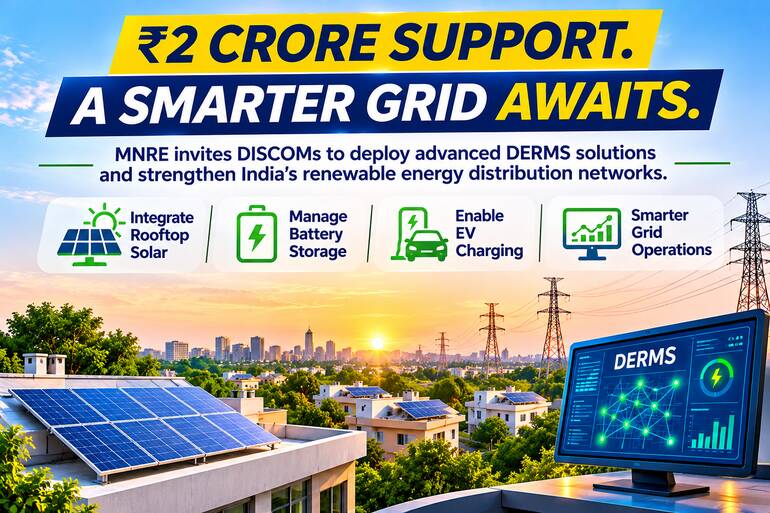
The Ministry of New and Renewable Energy (MNRE) has introduced financial assistance of up to ₹2 crores per distribution company (DISCOM) to accelerate the deployment of Distributed Energy Resource Management Systems (DERMS) projects across India. The initiative aims to strengthen electricity distribution networks by enabling better integration and management of rooftop solar, battery energy storage and other distributed renewable energy resources.
Under the DERMS projects initiative, MNRE will provide financial support covering up to 60% of the approved project cost, subject to a maximum of ₹2 crores per DISCOM. The National Institute of Solar Energy (NISE) issued a Call for Proposal (CfP) on 20th November, 2026, under the PM Surya Ghar: Muft Bijli Yojana, inviting State DISCOMs, private DISCOMs, joint venture DISCOMs and Power Departments to submit proposals for implementing advanced grid management solutions. The top 15 proposals will be selected based on merit, budget availability and evaluation.
DERMS Projects to Address Grid Management Challenges
The proposed DERMS projects will cover distributed energy resources such as rooftop solar installations, solar pumps, small PV grids, battery energy storage systems (BESS), electric vehicle (EV) charging infrastructure and demand response resources.
The identified solution areas include real-time rooftop solar generation monitoring, GIS-based mapping of distributed energy assets, renewable generation forecasting, voltage regulation, grid congestion management and dynamic hosting capacity assessment. The initiative also encourages virtual power plant (VPP) concepts, battery dispatch optimization, community storage models, managed EV charging, vehicle-to-grid (V2G) pilots, AI-based forecasting and digital twins.
Each selected project must cover at least one distribution division and demonstrate measurable operational and consumer benefits. Evaluation will prioritize innovation and technical feasibility (30%), expected impact on grid operations (20%), scalability and replicability (20%), consumer benefits (15%) and cost-effectiveness (15%).
Selected DISCOMs will be required to complete implementation within six months of receiving the sanction letter. The projects are expected to improve grid visibility, renewable energy forecasting, voltage management and the integration of distributed energy resources.
Opportunities for Renewable Energy and Technology Companies
The rollout of DERMS projects could open new opportunities for technology providers, solar EPC contractors, BESS developers, software companies and smart-grid solution providers. DISCOMs can engage technical firms and system integrators for equipment supply, software development, installation and commissioning through their procurement processes.
As rooftop solar installations and decentralized energy assets expand, advanced digital platforms will become increasingly important for maintaining distribution grid reliability and accommodating higher renewable energy penetration.
Interested DISCOMs and Power Departments must submit their proposals to NISE by 20th December, 2026, through the prescribed application process.
The initiative marks an important step towards modernizing India’s electricity distribution infrastructure and strengthening the digital capabilities required for its expanding renewable energy ecosystem.
