



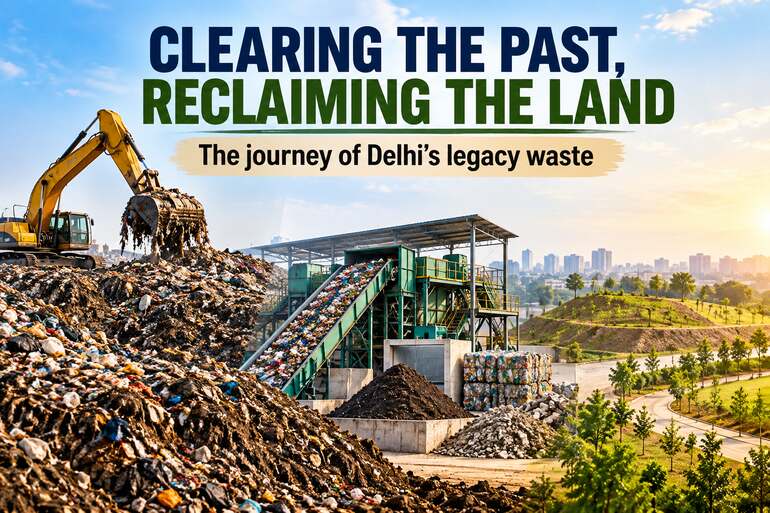
Delhi’s landfills face a challenge that is not limited to the waste generated today. Large quantities of garbage have accumulated over years at the city’s major dumpsites, creating what is known as legacy waste.
But what happens to this old waste once a landfill begins to be cleared?
The answer increasingly involves biomining and bioremediation: processes designed to treat accumulated waste, recover usable materials and reduce the volume of material that ultimately requires disposal.
What Is Legacy Waste?
Legacy waste is essentially old waste that has accumulated at a dumpsite over a long period, often without adequate processing or scientific treatment. Unlike freshly generated municipal waste, legacy waste can contain a mixture of organic material, plastics, soil-like material, construction debris and other discarded items. This makes its treatment more complex.
Delhi’s three major landfill sites: Okhla, Bhalswa and Ghazipur have been at the centre of efforts to reduce accumulated waste.
Delhi’s Economic Survey 2025-26 reported that the three dumpsites had about 280 lakh metric tonnes of legacy waste in 2019, with MCD reporting that 204.94 lakh metric tonnes had been biomined by November 16, 2025. The same document listed different projected completion timelines for remediation at the three sites.
How Is Old Landfill Waste Processed?
One of the main approaches is biomining. In simple terms, accumulated waste is excavated and processed so that different materials can be separated. The recovered material can include recyclables and other fractions that can potentially be used or processed further. Material that cannot be recovered or put to another use may still require appropriate disposal.
Bioremediation is another part of dumpsite remediation. It involves biological treatment of suitable waste fractions to reduce environmental impacts and improve the condition of the site.
The objective is not simply to move garbage from one location to another. The broader aim is to reduce the volume of accumulated waste, recover useful material and reclaim land.
Why Delhi Landfills Need Legacy-Waste Cleanup
The scale of Delhi landfills makes remediation an important part of the city’s wider waste management strategy. Large landfill sites occupy valuable urban land and can create environmental and operational challenges. The government has increasingly linked dumpsite remediation with land reclamation, while the 2026 waste management framework places specific emphasis on mapping and assessing legacy waste dumpsites and carrying out time-bound biomining and bioremediation.
That makes legacy waste clearance an important part of Delhi’s wider waste strategy. But there is another challenge.
Clearing Old Waste Is Only Half The Job
If new waste continues to accumulate faster than it can be processed, a cleared area can eventually face the same problem again. That is why Delhi’s current approach is increasingly focused on two parallel tasks: dealing with the waste already accumulated at landfill sites while expanding capacity to process fresh waste.
The distinction matters. Legacy waste remediation deals with yesterday’s garbage. Fresh waste processing is intended to prevent today’s garbage from becoming tomorrow’s legacy waste.
That is the larger context behind Delhi’s latest push to establish additional waste processing facilities.
What Happens Next?
The effectiveness of landfill remediation will depend not only on how much old waste is removed, but also on how the waste generated every day is managed. Source segregation, collection, transportation, processing and recovery therefore become critical parts of the same system. The ongoing work at Delhi landfills is also shifting attention towards a more efficient system that manages waste at every stage, from collection and processing to recovery.
The larger opportunity is to strengthen waste processing and resource recovery while supporting cleaner, better-managed urban spaces. As legacy waste is cleared and fresh waste is processed more effectively, Delhi can move towards a more integrated approach to waste management.
