



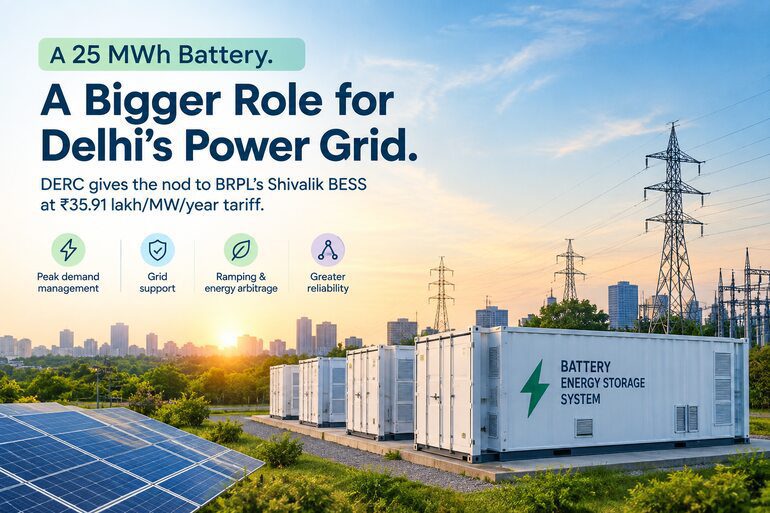
The Delhi Electricity Regulatory Commission (DERC) has approved the levelized tariff and Battery Energy Storage System Agreement (BESSA) for BSES Rajdhani Power Limited’s (BRPL) proposed 12.5 MW/25 MWh Battery Energy Storage System (BESS) at the 33/11 kV Shivalik Grid in Delhi.
In its order dated 09th September, 2026, DERC approved a tariff of ₹35.91 lakh per MW per year, excluding applicable GST for the project. The tariff was discovered through a competitive bidding process conducted by BRPL with The Energy and Resources Institute (TERI) serving as the bid manager.
The Commission also approved execution of the BESSA between BRPL and the successful bidder, REConnect Energy Solutions Limited, subject to specified modifications to the agreement.
Competitive Bidding Brings Down Shivalik BESS Tariff
The Shivalik project was tendered on a Build, Own, Operate and Transfer (BOOT) basis. Five bids were received, with Oriana Power, REConnect Energy Solutions and Ampere Hour Solar Technology qualifying for the financial bidding stage.
Oriana Power initially emerged as the L1 bidder with a quoted tariff of ₹36,00,000 per MW per year. An e-Reverse Auction was subsequently conducted on 21st January, 2026, after which REConnect Energy Solutions emerged as the successful bidder with a final tariff of ₹35.91 lakh per MW per year, excluding taxes.
The tariff represents a significant reduction compared with BRPL’s earlier 20 MW/40 MWh Kilokari BESS project, for which the discovered tariff was around ₹57.59 lakh per MW per year. DERC noted that the tariff discovered for the Shivalik project was lower than the earlier BRPL project.
However, the regulatory order also points out that Shivalik is a small-capacity, urban distribution-level project and is not directly comparable with large-scale BESS tenders supported by Viability Gap Funding.
Also Read: AI BESS Gains Ground as LG Energy Solution Qualifies for NVIDIA DSX Ready
Shivalik Project Designed for More Than Energy Storage
The proposed BESS is intended to provide several grid-level functions as Delhi’s electricity network experiences rising demand and increasing requirements for flexibility. According to the petition, the Shivalik Grid area has recorded a 5.42% compound annual growth rate in annual peak demand over the previous six years. BRPL identified the BESS as a means of supporting capacity augmentation deferral, peak-demand reduction, energy arbitrage, ramping support, resource adequacy and grid support.
The project is also intended to provide backup supply to critical loads through islanding operations and support other grid requirements. A notable feature of the project is the proposed use of grid-forming inverters. The DERC order records that the Shivalik installation will involve grid-forming technology and is envisaged as a pilot for grid-forming operations at the distribution level.
Unlike conventional grid-following inverters, grid-forming systems can provide advanced control functionalities including Virtual Synchronous Machine operation, droop control and inertia. The project also includes integration with the National Renewable Dispatch and Load Centre (NRDLC) for ancillary services, along with the shifting and restoration of an existing 100 kWp solar PV system and a 466 kWh BESS.
Also Read: Dilip Buildcon Unlocks Value From 1,363 MW Solar Portfolio in Alpha Alternatives Deal
DERC Approves BESS Agreement With Conditions
While approving the BESSA, DERC directed BRPL to incorporate several changes before signing the agreement with the developer.
The Commission identified issues relating to the agreement’s date, references to the Shivalik Grid, provisions concerning the signing timeline, project-capacity terminology and certain contractual clauses. BRPL was directed to incorporate these changes into the BESSA before executing it with REConnect Energy Solutions. DERC also found that the modifications made to the BESSA did not constitute deviations from the Ministry of Power’s 2022 BESS guidelines.
Consumer Benefit Linked to BESS Performance
An important part of the order concerns the treatment of financial benefits arising from the project. DERC directed BRPL to submit details of the net benefits accrued from the BESS project annually. The Commission further stated that any monetary benefits to BRPL from operation of the project are to be passed on entirely to consumers through the company’s Aggregate Revenue Requirement (ARR), as a net-off against power purchase costs.
The Commission has also directed BRPL to submit details of benefits arising from energy arbitrage every six months. It said that future projects of this nature should be taken up after considering the past performance of arbitrage benefits.
The regulatory approach places the Shivalik project within a broader framework in which battery storage is treated not only as a backup asset but also as a resource that can support distribution-grid flexibility and power procurement optimization.
Also Read: Tungaloy and NTK Cutting Tools Combine Expertise in Major 2027 Merger
What the Shivalik Approval Signals for Delhi’s Storage Market
The DERC order provides another indication of how battery storage is being incorporated at the distribution-network level in Delhi. The project follows BRPL’s earlier Kilokari BESS initiative and introduces a smaller urban installation with additional grid-forming capabilities. The competitive bidding process has also produced a lower discovered capacity tariff than BRPL’s earlier project, although the Commission’s order makes clear that the two projects have different technical and project characteristics.
With DERC now approving both the tariff and the BESSA, the Shivalik project can proceed towards implementation subject to compliance with the Commission’s directions and execution of the agreement.
The project positions battery storage as more than a backup or energy-shifting solution for Delhi’s distribution network. It is intended to function as a versatile grid resource, supporting demand management, system flexibility, ancillary services and broader network performance.
