



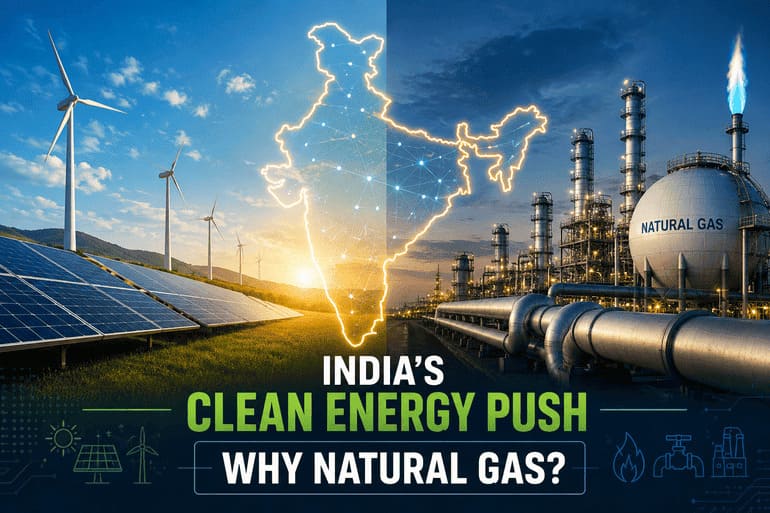
Every few days, headlines celebrate India’s renewable energy journey. A new solar park is inaugurated. Wind power capacity expands. Green hydrogen projects attract fresh investments. Ambitious targets are announced to build one of the world’s largest clean energy ecosystems.
Yet, alongside these developments, another set of headlines quietly emerges. New LNG terminals are being commissioned. Thousands of kilometres of natural gas pipelines are under construction. City Gas Distribution networks continue to expand, while industries are increasing their use of natural gas.
At first glance, these two stories appear to contradict each other. If India is accelerating its transition towards clean energy, why is it still investing heavily in natural gas?
The answer reveals something important about how energy transitions actually work. Contrary to popular belief, moving towards a low-carbon future isn’t about replacing one fuel overnight. It is about building an energy system that remains reliable, affordable and capable of supporting a rapidly growing economy while cleaner technologies continue to scale. Natural gas, for now, is playing an important role in that journey.
The Growing Demand for Natural Gas
India’s demand for natural gas has steadily increased over the past few years, driven by industries that require a reliable and relatively cleaner fuel. The petrochemical industry uses it as an essential feedstock for producing chemicals and plastics. Fertilizer manufacturers depend on it for ammonia production, while refineries use it in various industrial processes. The power sector also relies on gas-fired plants to provide electricity when needed, particularly during periods of peak demand.
Beyond industry, natural gas is becoming increasingly common in everyday life. Compressed Natural Gas (CNG) is widely used in public transport and commercial vehicles, while Piped Natural Gas (PNG) is expanding into households and commercial establishments through City Gas Distribution networks.
As India’s economy continues to grow, energy demand is expected to rise across multiple sectors, making natural gas an important part of the country’s evolving energy mix.
Also Read: Government Clarifies No Proposal to Blend Ethanol with Aviation Turbine Fuel
Why Renewables Alone Cannot Meet Every Energy Need
Solar and wind energy have transformed India’s power sector and will remain central to the country’s long-term sustainability goals. However, renewable energy has one inherent challenge; it depends on natural conditions. Solar power generation drops after sunset, while wind generation varies depending on weather patterns. Although battery storage technologies are advancing rapidly, large-scale storage remains expensive and is still developing.
Many industries cannot afford interruptions in electricity supply. Manufacturing plants, hospitals, refineries, data centres and transport systems require continuous power throughout the day and night. This is where natural gas becomes valuable. Gas-fired power plants can start and stop much faster than conventional coal-fired plants, allowing them to respond quickly when renewable generation fluctuates. This flexibility helps maintain grid stability while enabling greater integration of renewable energy into the power system. Rather than competing with renewable energy, natural gas often works alongside it.
Supporting Energy Security
India imports a significant share of its crude oil requirements, making energy security a key national priority. Diversifying energy sources helps reduce the risks associated with supply disruptions and volatile international fuel prices. While natural gas is also imported in the form of Liquefied Natural Gas (LNG), the country is simultaneously investing in domestic gas production, pipeline infrastructure and storage facilities to strengthen long-term resilience.
Government initiatives such as the National Gas Grid and the expansion of City Gas Distribution networks aim to improve access to natural gas across industries and urban centres, ensuring that cleaner fuels become more widely available. Strengthening energy infrastructure is therefore not only about meeting current demand but also about preparing for future economic growth.
Natural Gas and India’s Industrial Growth
India’s ambition to become a global manufacturing hub will require dependable energy supplies. Sectors such as steel, cement, chemicals, fertilizers and petrochemicals require high-temperature heat that renewable electricity alone cannot always provide economically. Natural gas offers industries a cleaner alternative to coal and liquid fuels while helping improve operational efficiency and reduce local air pollution.
As manufacturing expands under initiatives such as “Make in India”, demand for reliable industrial energy is likely to remain strong, reinforcing the role of natural gas during the transition period.
The Challenges Ahead
Despite its advantages, natural gas is not without challenges. India continues to depend on imported LNG to meet a substantial portion of its demand, exposing the country to global price fluctuations and geopolitical uncertainties. Events such as international conflicts or supply disruptions can significantly affect fuel costs.
There are also environmental considerations. Although it emits less carbon dioxide than coal when burned, methane emissions during production and transportation remain a concern because methane is a potent greenhouse gas. Addressing these challenges will require investments in pipeline infrastructure, improved storage capacity, advanced monitoring technologies and policies that encourage efficient and responsible use of natural gas.
Also Read: How AI Infrastructure Could Power India’s Next Economic Revolution
The Road Ahead
India’s energy future is unlikely to depend on a single source of energy. Instead, it will be shaped by a balanced mix of renewable energy, natural gas, hydroelectric power, nuclear energy, battery storage and emerging technologies such as green hydrogen. Each energy source has a distinct role to play.
Solar and wind will continue driving the expansion of clean electricity generation. Battery storage will help improve grid flexibility. Green hydrogen could transform hard-to-abate industrial sectors. Natural gas is expected to serve as a bridge fuel, helping maintain energy reliability while cleaner technologies continue to scale.
The Bigger Picture
India’s clean energy transition is not simply about replacing one fuel with another. It is about building an energy system that is reliable, affordable and capable of supporting one of the world’s fastest-growing economies. Natural gas is likely to remain an important part of that journey, not because it is the final destination, but because it can help bridge the gap between today’s energy needs and tomorrow’s low-carbon future.
As renewable energy capacity continues to expand and new technologies mature, its role may gradually evolve. For now, however, it remains a practical solution for supporting industries, strengthening energy security and ensuring the stability of an increasingly complex power system.
Ultimately, India’s energy transition will be defined not by choosing one energy source over another, but by finding the right balance to deliver sustainable growth while meeting the country’s long-term climate and development goals.
