



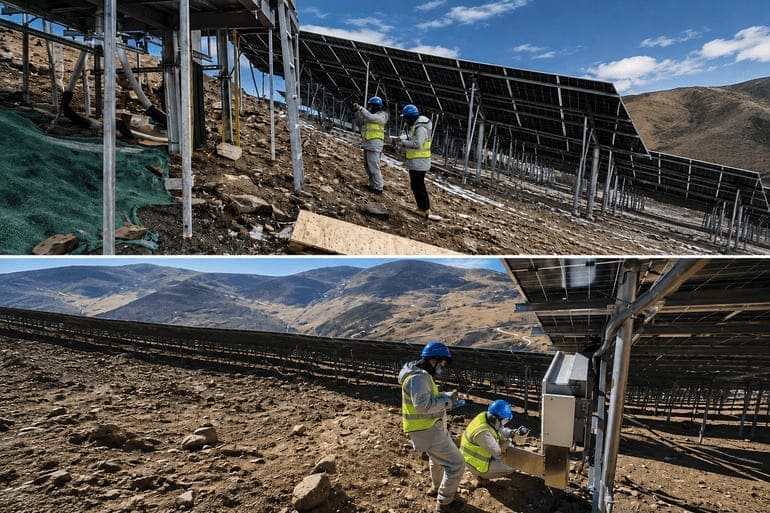
As global investments in photovoltaic (PV) power generation continue to grow, efficient operation and maintenance (O&M) has become increasingly important for ensuring system reliability, safety, and long-term performance. China, which accounts for more than 40% of the world’s installed photovoltaic capacity is witnessing rapid expansion of utility-scale solar projects while facing challenges such as output fluctuations, operational risks, maintenance inefficiencies, and rising inspection costs.
To address these challenges, thermal imaging technology is increasingly being adopted as a predictive maintenance solution. A recent field application at an 80 GW integrated hydro-wind-solar power base in Southwest China demonstrated how the Flir T540 professional infrared thermal camera equipped with the FlexView dual field-of-view lens helped operation and maintenance teams identify critical equipment issues and improve inspection efficiency across the facility.
Also Read: KEI Industries Approves ₹700 Crore Capacity Expansion at Rajasthan Manufacturing Unit
Core Application Scenario: Full-Chain Coverage for Power Plant O&M
The Flir T540 paired with the FlexView dual field-of-view lens enables users to switch instantly between a 24° standard field of view and a 14° telephoto field of view without changing lenses manually. This capability allows inspection teams to quickly identify faults while maintaining inspection accuracy across large photovoltaic installations.
Using thermal imaging as part of a proactive maintenance strategy, the operations team was able to balance inspection efficiency with precise fault detection while reducing maintenance time and operational costs.
Module Inspection: Locating Faults in Core Power-Generating Units
The field test highlighted several module inspection applications where thermal imaging supported early fault identification.
Hot-Spot Effect Detection
Module defects caused by shading, physical damage or diode failure appear as hot-spot regions with temperature differences exceeding 5°C. The Flir T540 accurately identified these abnormalities, enabling repairs within 24 hours and helping prevent 20% to 50% power loss.
Micro-Crack and Cold-Solder Detection
Micro-cracks and cold-solder joints produce linear or mesh-like low-temperature patterns with temperature differences of approximately 1°C. The thermal camera detected these subtle defects, allowing repairs within 72 hours and contributing to longer module service life.
PID Degradation Detection
Potential Induced Degradation (PID) creates stripe-shaped high-temperature zones along module edges. The Flir T540 identified these thermal patterns, allowing corrective action within seven days to minimize further degradation.
Equipment Inspection: Ensuring Stable Operation of Critical Devices
Beyond module inspections, the Flir T540 was also deployed for monitoring several critical power plant components.
Inverter and Transformer-Box Inspection
Thermal imaging enabled early detection of overheating on heat sinks and electrical terminals, helping prevent equipment failures while improving conversion efficiency by 3% to 5%.
Battery Bank Inspection
The camera identified abnormal temperature rises and localized overheating, allowing operators to address issues before they affected battery performance or caused equipment damage.
Insulated Busbar Inspection
Early-stage insulation aging and poor electrical contacts were detected using thermal imaging, reducing the risk of short circuits and fire hazards.
SVG and Incoming Cables
Abnormal temperature increases in SVG power modules, reactors and cable joints were identified before they developed into larger operational issues, helping minimize equipment degradation and downtime.
Also Read: Advait Energy Partners with MEIL to Drive Future Energy Technologies
Safer Inspections
The FlexView dual field-of-view lens also enabled maintenance personnel to perform inspections from safer distances while identifying potential short-circuit risks without approaching live equipment.
Support Structure and Mechanical Inspection
Temperature anomalies caused by structural deformation or loose mechanical components were detected, enabling timely maintenance and reducing potential power losses.
Transmission Line Inspection
Thermal imaging was also used to identify hotspots caused by poor electrical contact or overloaded transmission lines, supporting timely repairs and improving transmission reliability.
According to the field test, the combination of the Flir T540 professional infrared thermal camera and the FlexView dual field-of-view lens supports a more proactive approach to photovoltaic operation and maintenance.
By enabling early fault detection, improving inspection efficiency, reducing operation and maintenance costs, and strengthening safety management, thermal imaging technology can help utility-scale photovoltaic facilities improve reliability while supporting the long-term performance of renewable energy assets.
The Southwest China field application demonstrates how predictive thermal imaging solutions are contributing to the evolution of modern PV operation and maintenance through technology-driven inspection and preventive maintenance practices.
