



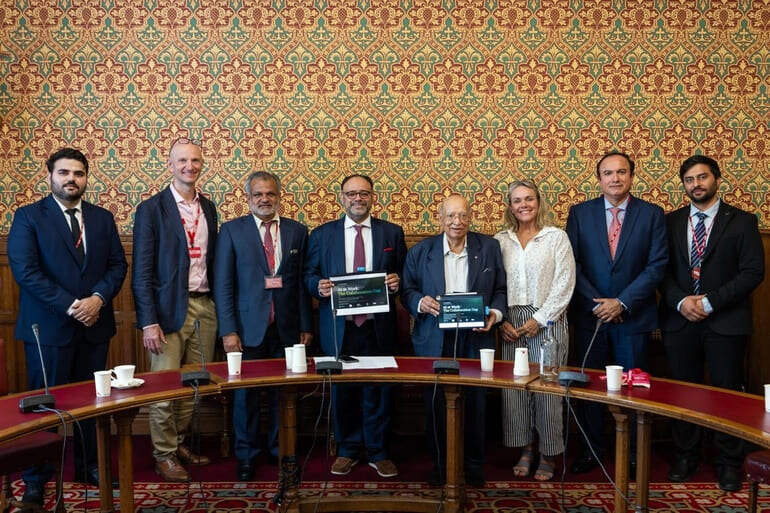
As AI becomes a daily tool for millions of professionals, organizations are facing a new challenge: turning AI adoption into real business results. A global study released by CambrianEdge.ai reveals that 55% of professionals identify the lack of structured human-AI collaboration as their biggest productivity obstacle. The report highlights an emerging “AI Collaboration Gap” driven by missing workflows, quality standards, and review mechanisms needed for teams and AI to operate as a unified system.
The preliminary findings from the AI AT WORK: THE COLLABORATION GAP 2026 survey were presented at the House of Lords, London, by Harjiv Singh, Founder and CEO of CambrianEdge.ai. This was followed by a panel titled “Working with AI: A Perspective on Organizational Transformation”. The panel brought together Kristin Harlan, Head of Dean’s Communications at Stanford Graduate School of Business; Dr. Siddharth Saxena, Research Professor at the Cavendish Laboratory, University of Cambridge; Lord Raj Loomba CBE DL, Member of the House of Lords and Founder and Chairman of The Loomba Foundation; and Marcus Sigurdsson, Director at Typhoon 8, to discuss the research report and explore why collaboration remains the missing layer in how organizations are working with AI. The broader research was conducted in partnership with the Cambridge Central Asia Forum, Stanford SEED, US-India Strategic Partnership Forum (USISPF), Gutenberg, Digimentors, and Brand Communion.
The report highlights what it terms a “transformation illusion,” referencing independent data from a concurrent BCG study of 300 global CMOs. While 96% of those executives claimed AI is driving end-to-end transformation, nearly half still limit its application to discrete, isolated tasks performed by individual employees.
“Most organizations spent the last two years asking which AI model to subscribe to, forgetting to ask how their teams were supposed to work with it,” said Harjiv Singh, Founder and CEO of CambrianEdge.ai. “Adding AI to a system built for siloed work is like putting electric lights in a building designed for candles; the architecture needs to change, not just the bulbs. True economic value only materializes when companies abandon a fragmented stack of individual tools and build a shared, continuous workflow.”
To compare survey perceptions with empirical data, the research tracked 775 users across 104 organizations, spanning enterprises, marketing agencies, startups, law firms, and educational institutions. The evidence reveals that the operational landscape shifts entirely when teams abandon disjointed tools for an AI-native collaborative platform. By consolidating research, creation, distribution, and analysis into a unified environment, organizations replace fragmented individual habits with a continuous team workflow. This transition yielded a 98% active engagement rate post-onboarding, causing foundational concerns regarding security, skills, and ROI justification to fade. Instead, 56% of these platform users report that their sole remaining obstacle is execution velocity, or how fast they can move.
“AI has arrived at a threshold where the technology is ready, but the organizational architecture has not kept pace,” said Lord Raj Loomba CBE DL, Member of the House of Lords and Founder and Chairman of The Loomba Foundation. “If we do not address this through deliberate design, we risk reducing a transformative technology to a mere collection of individual tools. The conversations we must have now, in Parliament and in boardrooms alike, must ensure that as we shape this future, intelligence remains human.”
The report also has direct guidance for enterprise executives and policymakers alike. Organizations must formally define how work moves from AI generation to human review and final deployment before attempting to scale adoption. Success depends on systematically introducing the missing layers of shared access, standardized prompts, and quality control, while national AI readiness metrics must evolve to measure workforce fluency over simple tool adoption rates.
Key Findings Include:
- The Infrastructure Multiplier: Among organizations operating with no infrastructure layers, only 32% report significant impact from AI. That figure rises to 100% for organizations that have instituted all five critical layers: shared tool access, formal training, prompt libraries, quality standards, and mandatory review processes.
- The Handoff Deficit: Defined handoff processes nearly double the likelihood of project success, driving significant outcomes at 71% compared to just 38% for unstructured workflows. Currently, 62% of organizations have no defined process for handing off AI-generated work to human review.
- The Risk of Regression: The cost of failing to build this infrastructure is regression rather than stagnation. Eighteen per cent of surveyed organizations have already rolled back or abandoned AI initiatives entirely, citing severe quality collapses and systemic adoption failures.
- The Collaboration Void: Twenty-seven per cent of organizations operate with zero collaboration infrastructure, lacking shared access, prompt libraries, training, or quality standards.
The full preliminary findings from the AI AT WORK: THE COLLABORATION GAP 2026 Survey are available at https://cambrianedge.ai/ai-at-work-collaboration-gap
