



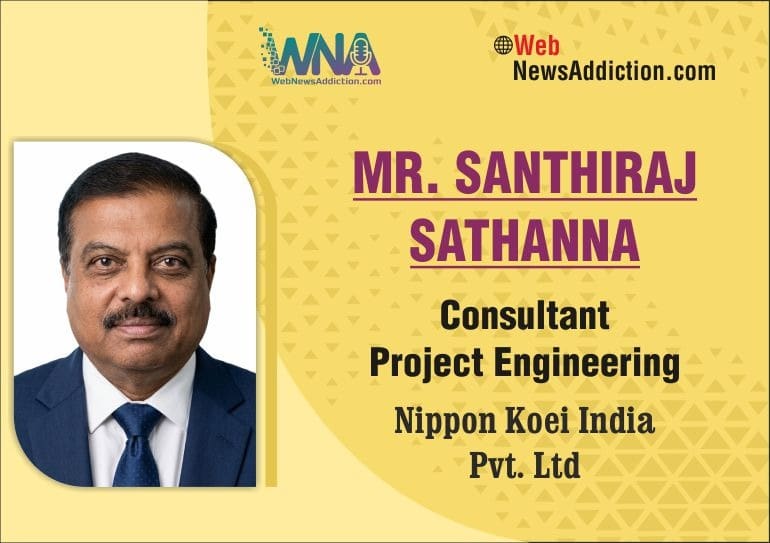
In complex industrial energy and utility ecosystems, execution excellence is rarely defined at the construction stage. It is shaped much earlier in how seriously organizations approach planning, risk structuring, and front-end decision-making.
Drawing from large-scale industrial infrastructure environments, Mr. Santhiraj Sathanna, Consultant – Project Engineering, Nippon Koei India Private Ltd highlights a defining shift in execution philosophy:
Mr. Santhiraj Sathanna states, “Beyond hybrid project management and textbook risk controls, Gulf execution runs on a different engine altogether. It’s not cautious—it’s calculated, front-loaded, and ruthlessly disciplined.”
The Discipline That Shapes Execution
At the core of successful mega-project delivery lies front-end discipline — a phase that determines downstream certainty.
Mr. Santhiraj Sathanna explains, “Front-End Loading isn’t a phase—it’s a weapon.”
This early-stage rigour ensures scope clarity, design maturity, and cost predictability before execution begins. Independent engineering expertise is embedded early to strengthen reliability, safety, and lifecycle performance while ensuring value optimization.
Approval processes, procurement planning, and interface management are executed in parallel streams, eliminating idle time and reducing execution uncertainty.
Mr. Santhiraj Sathanna emphasizes the execution philosophy behind this approach, “Gulf C-suites don’t gamble on execution—they overinvest in planning.”
Risks Hidden Beneath Assumptions
In power plants, ports, and water treatment systems, the most critical risks are often not visible in equipment — but embedded in early assumptions.
Mr. Santhiraj Sathanna observes, “In power plants and water treatment projects, the real risk isn’t what you see—it’s what you assume.”
One of the most underestimated variables is raw water variability, which can shift over time and impact entire process designs.
Mr. Santhiraj Sathanna highlights this uncertainty, “Raw water is a shape-shifter.”
When such assumptions fail, entire treatment philosophies may require redesign, often triggering expensive system interventions. Brownfield environments amplify this complexity, where interventions occur within live operating systems.
Mr. Santhiraj Sathanna explains the intensity of such environments, “This isn’t construction—it’s open-heart surgery on a running system.”
Success depends less on optimism and more on preparation, scenario modeling, and engineering for variability rather than averages.
Automation as an Industrial Necessity
Industrial operations today are shaped by cost pressures, scale demands, and stringent quality expectations.
Mr. Santhiraj Sathanna states, “Given the situation of rising cost of human capital, demanding output product quality norms coupled with high volume production, make automation non-negotiable.”
Automation is no longer an enhancement — it is a structural requirement for efficiency, reliability, and competitiveness.
Modernization in Live Environments
Brownfield modernization represents one of the most complex operational challenges in industrial systems.
Mr. Santhiraj Sathanna emphasizes, “Obsolescence doesn’t whisper. It kicks the door in and demands a rebuild.”
Execution success depends on precise coordination between engineering and operations teams, where every shutdown, isolation, and cutover must be executed without disrupting production continuity.
Mr. Santhiraj Sathanna further explains, “One wrong valve, one mistimed switch, and the whole system feels it.”
The Next Phase of Industrial Transformation
Industrial systems are entering a phase of deep digitalization, automation, and structural redesign of utility models.
Mr. Santhiraj Sathanna states, “Digitalization isn’t knocking. It’s already inside, rewiring the factory floor.”
This shift is enabling dark factories, AI-assisted operations, and robotics-led production systems, while also redefining how utilities are delivered and managed.
Utility models are evolving towards service-based frameworks, allowing organizations to focus on core production while specialized operators manage infrastructure systems.
Where Industrial Intelligence Converges
As industrial ecosystems evolve, utilities are becoming more intelligent, plants more autonomous, and infrastructure more deeply integrated with digital systems. The focus is increasingly shifting towards resilience, cyber-secure automation, and execution intelligence across the lifecycle of industrial assets.
The next phase of industrial development will be defined by how effectively organizations adapt to this convergence of efficiency, automation, and operational reliability in real-world execution environments.

1 Comment
Pingback: Hitachi Vantara Named Leader in GigaOm Object Storage 2026