



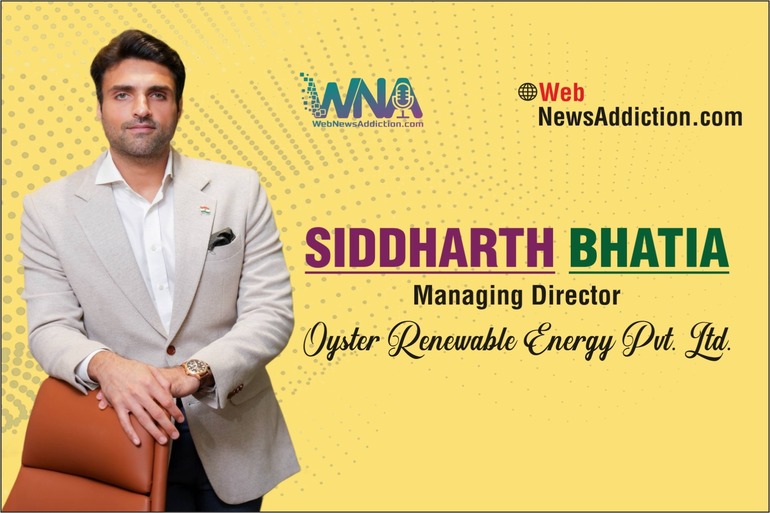
India’s clean energy transition greatly depends on advanced hybrid solutions that integrate wind, solar, and Battery Energy Storage Systems (BESS) to deliver stable, grid-compliant power. Oyster Renewable Energy, led by its Managing Director, Siddharth Bhatia is a key industry player driving this paradigm shift through scalable, technology-optimized projects.
In an exclusive interaction with Web News Addiction, Siddharth Bhatia, Managing Director, Oyster Renewable Energy Pvt. Ltd., shares valuable insights into the company’s vision and strategic focus on hybrid renewable energy solutions. Further, he discusses how Oyster is leveraging the power of wind-solar integration, advanced battery storage, and innovative digital technologies to drive scalable, reliable, and round-the-clock clean energy projects across India.
Excerpts Below:
• Please begin by letting us know a bit about your company’s vision.
At Oyster Renewable Energy, our vision is to build future-ready renewable energy assets that combine scale, innovation, and reliability. We believe the next decade of India’s clean energy growth will be driven by hybrid systems, storage integration and grid-centric solutions, and our ambition is to be at the forefront of that transformation. Our focus is on delivering high-performance projects that create long-term value for the grid, investors, and communities.
• What are your business’s key focus areas in the renewable energy domain?
Our core focus is on hybrid renewable assets, particularly wind–solar combinations supported by Battery Energy Storage Systems (BESS). These solutions allow us to deliver more stable and dispatchable power. Alongside this, we prioritize transmission readiness, advanced forecasting, and technology-led O&M models to ensure project longevity and optimal performance.
• Can you tell us a little about the key operational challenges at this stage of your projects?
As our projects grow in scale, the most significant challenges involve land aggregation, transmission availability, and timely equipment delivery. Coordinating civil, electrical and transmission activities simultaneously across large geographic footprints requires disciplined project management. Weather-related delays and supply-chain unpredictability also add layers of complexity.
• How critical is Battery Energy Storage (BESS) for ensuring RTC power delivery in hybrid renewable projects?
BESS is absolutely central to achieving Round-the-Clock (RTC) renewable power. Storage provides the essential flexibility required to smooth out intermittency, maintain grid stability, and deliver predictable schedules. For developers like us, BESS is not just an add-on-, it’s a strategic enabler that elevates renewable assets from variable sources to reliable power solutions.
• As you plan new projects, what challenges do you expect when it comes to integrating battery storage systems?
The primary challenges lie in cost, regulatory clarity, and long-term performance guarantees. Storage still carries a high capital cost, and tariff structures for RTC supply need further refinement. Integrating BESS with hybrid systems also requires advanced controls, forecasting, and grid compliance, all of which call for specialized technical expertise.
• Are there any storage technologies or partners you’re looking into right now?
We’re evaluating multiple lithium-ion and emerging long-duration storage technologies. Our approach is technology-agnostic- we prioritize reliability, safety, and lifecycle economics. We have ongoing discussions with both global and domestic storage providers, but our final choices will align with project-specific needs and long-term performance benchmarks.
• How do you decide the best way to balance solar and wind in a hybrid system?
We design hybrid systems based on site resource profiles, grid requirements, and projected dispatch obligations. Solar and wind complement each other naturally, but the final mix is determined by deep resource modelling, generation profiles, and the required firmness of supply. Storage plays a key role in refining this balance.
• In your experience, how has the hybrid IPP model helped improve things like cost efficiency or grid performance?
The hybrid IPP model enables higher CUFs, better transmission utilization, and smoother power output, which directly improves grid performance. It also allows us to optimize capex by sharing infrastructure such as land, evacuation systems, and O&M facilities. Overall, it results in more efficient projects and more competitive tariffs for off-takers.
• What’s next after the 281 MW hybrid project? Are there plans to scale up capacity in the near future?
Yes, we are actively pursuing larger hybrid portfolios and storage-integrated projects across multiple states. Our goal is to significantly scale up our operational capacity over the next few years and establish Oyster as a leading player in high-performance hybrid and RTC renewable solutions.
• How is the 21 MWp / 14.46 MW solar project in Kasargod coming along? Can you share more details?
The Kasargod project is progressing well, with key civil and electrical milestones currently underway. We have prioritized local engagement, efficient site development, and quality-focused execution. Once operational, the project will contribute to the region’s renewable supply and reinforce our commitment to delivering well-engineered, region-specific solar assets.
• What steps from regulators or policymakers would most help accelerate hybrid renewable and storage adoption?
Key enablers would include clear storage regulations, supportive tariff structures, access to concessional financing, and faster approvals for transmission connectivity. A stable policy environment for hybrid-plus-storage projects will unlock major private sector investments and create a reliable pathway to RTC renewable power.
• What kinds of partnerships or investment areas are you currently exploring to boost scalability or innovation?
We are exploring partnerships across storage technologies, digital asset management, co-investment in hybrid portfolios, and transmission infrastructure development. Collaborations with global technology providers and domestic manufacturing partners are also part of our scaling strategy.
• In your experience, which emerging trends are likely to have the biggest impact on India’s renewable energy growth?
Three trends stand out:
- Hybridization of renewable assets
- Grid-scale battery storage
- Digitalization and AI-driven asset optimization
Together, these will shape the next wave of India’s clean energy expansion.
• Lastly, where do you see the most potential for collaboration or external input to help Oyster grow further?
We see strong potential in technology partnerships, co-development of hybrid-plus-storage assets, and investor collaborations for long-term capital. As we scale, external expertise in areas like advanced forecasting, digital O&M, and storage system optimization will also play a valuable role in accelerating our growth.
