



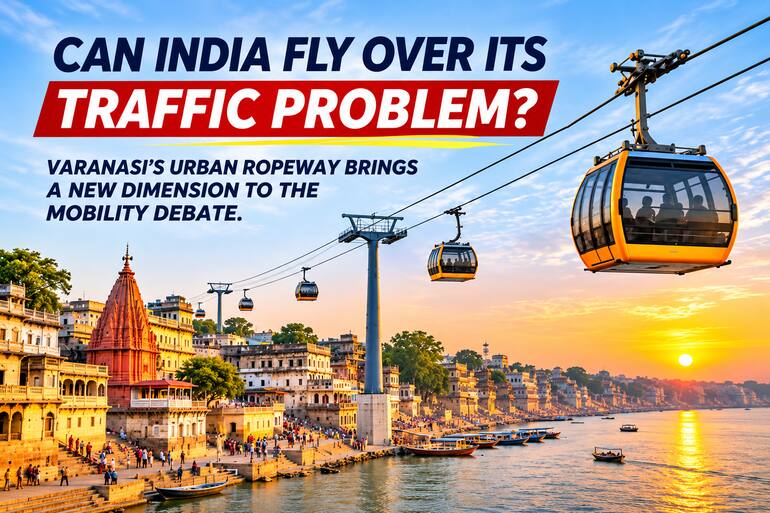
India’s urban transportation challenges are increasingly prompting discussions around alternative mobility solutions. As cities deal with growing passenger movement, road congestion and limited space for expanding conventional transport infrastructure, ropeways are emerging as another option for improving connectivity. The Varanasi Urban Ropeway project, being developed under the National Ropeways Development Programme – Parvatmala Pariyojana brings this approach into focus.
Unlike conventional ropeways commonly associated with hill stations and tourist destinations, the Varanasi project is being developed as an urban public transportation system. The 3.85-km corridor will connect Varanasi Cantt Railway Station with Godowlia Chowk, providing an aerial transport link through some of the city’s busy areas. The project is being implemented by National Highways Logistics Management Limited (NHLML), under the Ministry of Road Transport and Highways.
Also Read: FROM RISING DEMAND TO GLOBAL AMBITION: INDIA’S EQUIPMENT INDUSTRY AT A TURNING POINT
Why are ropeways gaining attention in India’s transportation planning?
Expanding transportation infrastructure in densely populated cities is not always straightforward. Acquiring land, widening roads and developing new transport corridors can involve significant planning and implementation challenges. In geographically difficult locations, conventional road and rail connectivity can also face limitations.
Ropeways offer a different approach by transporting passengers through suspended cabins supported by cables and towers. Since the system requires relatively limited ground-level infrastructure between supporting towers, it can be considered in locations where land availability is constrained.
The Ministry of Road Transport and Highways has highlighted this low-footprint characteristic as one of the advantages of ropeway infrastructure. The technology is being explored as an alternative transportation option for remote and hilly regions as well as congested urban areas.
Varanasi brings urban ropeway transportation into focus
The Varanasi Urban Ropeway is among the most prominent examples of this approach in India. Prime Minister Narendra Modi laid the foundation stone for the project on 24th March, 2023, marking the development of India’s first urban public transport ropeway.
According to NHLML’s project specifications, the 3.85-km system will have four passenger boarding and deboarding stations: Varanasi Cantt Railway Station, Vidyapeeth, Rath Yatra and Godowlia Chowk. An additional station at Girjaghar will serve as a technical facility without passenger boarding or deboarding.
The ropeway is designed to carry 3,000 passengers per hour in each direction. The project’s specifications also provide for 16 hours of daily operations across two shifts.
The passenger cabins will travel along suspended cables, allowing commuters to move between designated stations without depending entirely on road-based transportation. This could provide an additional connectivity option for residents, pilgrims and visitors navigating Varanasi’s busy urban corridors.
The project illustrates how ropeway technology that is traditionally associated with tourism and difficult terrain can also be considered within a city’s broader public transportation network.
Parvatmala Pariyojana: A wider push for ropeway infrastructure
The Varanasi project is part of the National Ropeways Development Programme announced in the Union Budget 2022-23 as Parvatmala Pariyojana.
The programme aims to develop more than 250 ropeway projects covering approximately 1,200 km over five years, providing an alternative to conventional road transportation, particularly in challenging geographical locations.
National Highways Logistics Management Limited has been entrusted with implementing the programme. The government has also linked the initiative with the ‘Make in India’ vision, stipulating that at least 50% of components used in ropeway construction should be indigenous.
The programme extends beyond urban connectivity. Ropeway projects are also being developed or planned for important religious destinations and difficult terrains, including Kedarnath and Hemkund Sahib in Uttarakhand.
This broader approach indicates that ropeways are being considered for multiple transportation requirements, ranging from urban passenger movement to pilgrimage connectivity and access to remote destinations.
Can aerial transit become a practical urban mobility solution?
The potential of ropeways lies in their ability to provide an additional transportation corridor without requiring continuous ground-level road space. For cities with congested streets and limited opportunities for expanding existing infrastructure, this characteristic could make them a useful complement to conventional public transport.
However, the success of urban ropeway systems will depend on more than their engineering and construction. Their integration with railway stations, bus terminals and other public transportation services will be important in ensuring convenient passenger movement.
Affordability will also influence adoption. Ticket pricing, accessibility for different passenger groups, service frequency and last-mile connectivity will determine whether ropeways become a practical option for everyday commuters or remain primarily useful for specific routes and tourist movement.
Operational reliability and safety will require equal attention. Weather conditions, regular maintenance, emergency evacuation arrangements and passenger safety procedures must be incorporated into the planning and operation of these systems.
These considerations are particularly important when ropeways are introduced into densely populated urban environments, where public transportation needs to serve passengers consistently throughout the year.
Also Read: CORPORATE ENERGY PROCUREMENT GETS A NEW MANDATE: POWER, PERFORMANCE AND PURPOSE
What lies ahead for India’s ropeway infrastructure?
India’s ropeway development programme reflects an effort to expand the country’s transportation options beyond conventional road and rail networks. The Varanasi project provides an opportunity to examine how aerial transportation can be incorporated into an urban setting, while projects in mountainous regions demonstrate its potential for improving access in challenging terrain.
Ropeways are unlikely to replace roads, metro systems or railways. Their value will depend on identifying locations where they can complement existing transportation infrastructure and address specific connectivity requirements.
As India’s cities continue to expand and infrastructure planners explore alternative mobility solutions, ropeway-based transportation could become an important part of the wider urban mobility conversation. The experience of projects such as Varanasi will be relevant in assessing where this technology can deliver practical, accessible and sustainable transportation options.

2 Comments
Pingback: ServiceNow Flags AI Agent Security Risks
Pingback: A New Market Beckons as Tata Motors Expands into Syria