



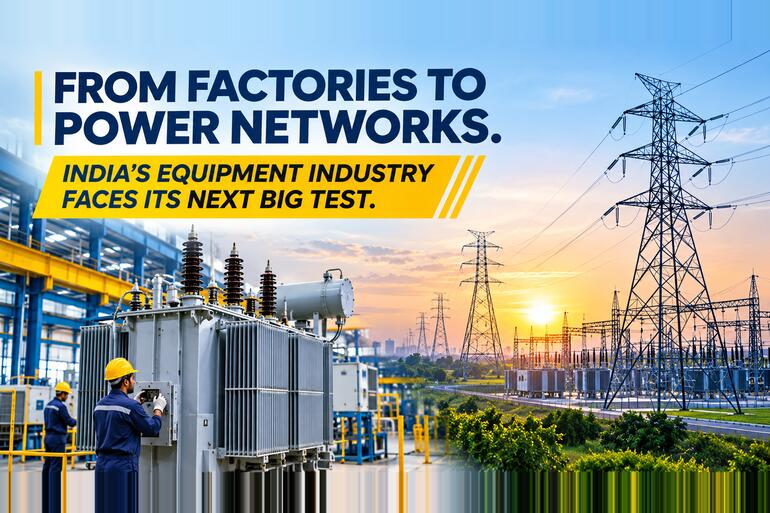
India’s expanding power sector is creating a growing demand for the equipment that keeps electricity flowing across the country. Transformers, switchgear, reactors, cables and other electrical components are becoming increasingly important as the country develops new power plants, renewable energy projects, transmission networks and industrial infrastructure. However, meeting this demand is becoming a challenge for the domestic manufacturing industry. Beyond expanding factory capacity, manufacturers must address the availability of specialized materials, component shortages, production timelines and the need for advanced technology.
When discussions turn to India’s power sector, attention generally goes towards solar parks, wind farms, electricity generation and transmission projects. But there is another important part of this ecosystem that often receives less attention: the manufacturing industry that produces the equipment needed to make these projects operational.
Consider a new solar power project. Generating electricity is only one part of the process. The electricity must also pass through transformers, substations and other electrical equipment before it can be transmitted through the network. Similarly, a new industrial facility or data centre requires specialized electrical equipment to receive and manage its electricity supply.
This makes the electrical equipment manufacturing industry an important part of India’s infrastructure development. As demand increases, the pressure on manufacturers and their supply chains is also growing.
Also Read: Fourth Partner Energy and GACL Join Forces to Reshape Industrial Power Sourcing
Manufacturing capacity is expanding, but is it enough?
India is preparing for a substantial increase in domestic transformer manufacturing capacity.
The industry is preparing to scale up production, with around 315 GVA of additional transformer manufacturing capacity planned over the next three years. This would take the country’s total capacity to nearly 690 GVA by FY2027-28 from the existing 375 GVA.
To understand why this matters, it is useful to look at the role of transformers. Electricity generated at power plants cannot always be transmitted at the same voltage at which it is produced. Transformers increase voltage for long-distance transmission and reduce it at different stages before electricity reaches homes, commercial establishments and factories.
In simple terms, transformers help electricity travel efficiently across the power network and reach consumers at usable voltage levels.
As India develops more power generation facilities, transmission corridors and industrial infrastructure, the requirement for different types of transformers is increasing.
However, having more manufacturing capacity does not automatically guarantee timely equipment availability. Manufacturers also need a steady supply of the specialized materials and components used in production.
Why a shortage of one component can delay an entire project
A large power transformer consists of several essential parts, each performing a specific function. Some of the materials used in its manufacturing require specialized production processes and strict quality standards.
One such material is Cold-Rolled Grain-Oriented (CRGO) steel, which is used to manufacture transformer cores. The core helps transfer electrical energy between the transformer’s windings while minimizing energy losses.
Another important component is the bushing. Although it is relatively small compared with the overall transformer, it performs a critical function by allowing electrical conductors to pass through the transformer’s grounded enclosure while maintaining insulation.
Copper conductors carry electricity through the transformer, while specialized insulation materials prevent unwanted electrical contact and help ensure safe operation.
A shortage of any one of these components can affect the entire manufacturing schedule.
Think of it like assembling a car. A manufacturer may have a fully operational factory, sufficient workers and production machinery, but if an essential component is unavailable, the vehicle cannot be completed on time.
The same principle applies to electrical equipment manufacturing.
However, manufacturers continue to face difficulties in sourcing essential materials such as CRGO steel, bushings, insulation and copper conductors. Addressing these gaps will be important to ensure smoother production and timely equipment deliveries.
Why does India still depend on imported materials?
An important challenge is the availability of specialized raw materials within the country.
CRGO steel is a notable example. India has historically depended heavily on imports to meet its requirements for this specialized steel. Such dependence can expose manufacturers to international supply disruptions, price fluctuations and longer procurement periods.
The challenge is not simply about producing more steel or establishing additional factories. CRGO steel requires specific magnetic properties that make it suitable for electrical applications. Achieving these properties consistently requires advanced manufacturing technology and considerable technical expertise.
The same applies to specialized insulation materials and certain high-voltage components.
For manufacturers, this means that expanding finished equipment production must go hand in hand with developing a stronger domestic supplier network. If the country continues to depend heavily on overseas suppliers for critical inputs, even an increase in domestic transformer manufacturing capacity may not completely eliminate production bottlenecks. Developing local capabilities will require investment in specialized manufacturing facilities, research, skilled manpower and quality-control systems.
Large transformers are not manufactured overnight
Another aspect that deserves attention is the time required to manufacture and deliver large power transformers.
Unlike standard electrical appliances, these transformers are engineered according to specific technical requirements. Their size, voltage rating, operating conditions and application determine their design and manufacturing process.
The longer delivery schedules for higher-voltage equipment reflect the complexity involved in manufacturing large transformers. The reported timelines stand at 11-15 months for 220 kV units and 20-24 months for 765 kV transformers.
Why should this concern the wider power sector?
Imagine a new electricity substation being developed to improve power supply to an industrial region. The land is ready, civil construction is complete and transmission lines have been installed. However, if the main transformer is delayed, the substation may not be able to become fully operational as scheduled.
This can affect project timelines and the availability of infrastructure needed to support electricity demand. Therefore, manufacturing lead times are not merely an issue for equipment suppliers. They have implications for power utilities, infrastructure developers and the wider economy.
Technology is changing the manufacturing landscape
The electrical equipment industry is also undergoing a technological shift.
As power networks become more complex, there is a growing need for equipment that can handle higher voltages, operate reliably under changing conditions and integrate with modern digital systems.
High-voltage and extra-high-voltage transformers, advanced switchgear, HVDC equipment and grid stabilization technologies are becoming increasingly relevant.
Digitalization is also changing how equipment is monitored and maintained.
For example, traditional maintenance often relies on scheduled inspections to identify wear and potential problems. Digital monitoring systems can continuously track operating conditions and help detect unusual behaviour before it develops into a major fault.
This can improve equipment reliability, reduce unexpected shutdowns and help operators plan maintenance more effectively.
For domestic manufacturers, the challenge is to develop these technological capabilities alongside production capacity. Competing in advanced equipment segments requires investment in research and development, testing infrastructure, engineering expertise and product innovation.
Building India’s Competitiveness in Global Power Equipment Manufacturing
The expansion of domestic manufacturing also presents an opportunity to strengthen India’s position in international markets. However, becoming a global supplier involves more than producing larger quantities of electrical equipment.
International buyers look for consistent quality, product reliability, competitive pricing, technical certifications and dependable delivery schedules. Manufacturers must also be able to provide technical support and maintenance services throughout the equipment’s operating life.
This means that Indian manufacturers will need to improve productivity, strengthen component supply chains and invest in advanced engineering capabilities.
There is also an opportunity to increase domestic value addition by developing suppliers for specialized materials and components that are currently sourced from overseas markets.
A stronger domestic ecosystem could help manufacturers become less vulnerable to international supply disruptions while improving their ability to compete in export markets.
The real challenge goes beyond building more factories
India’s electrical equipment manufacturing industry is entering an important phase. Rising electricity demand and infrastructure development are creating opportunities across several equipment categories. Manufacturing capacity is expanding and investments in technology and production facilities are becoming increasingly important.
However, the success of this expansion will depend on how effectively the industry addresses its underlying challenges.
The availability of specialized raw materials, timely access to components, manufacturing lead times, technological capabilities and skilled manpower will all influence how quickly domestic manufacturers can respond to rising demand.
The focus therefore needs to extend beyond increasing production capacity. India must develop a manufacturing ecosystem in which materials, components, engineering capabilities and finished equipment are supported by reliable domestic supply chains.
The next phase of growth for India’s power equipment industry will not simply be about manufacturing more. It will be about manufacturing better, reducing supply-chain vulnerabilities and building the capabilities to support the country’s power infrastructure for decades to come.
