



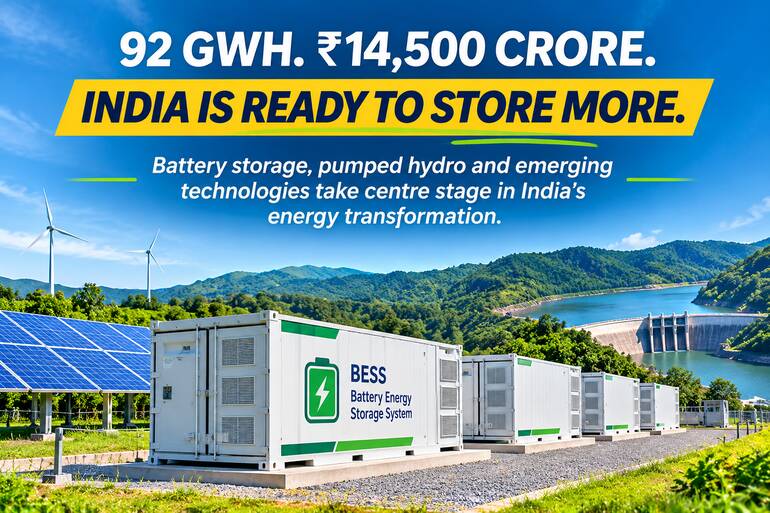
India’s Energy Storage sector is set for a major boost, with the Union Cabinet approving ₹14,500 crore in Viability Gap Funding (VGF) for the development of 92 GWh of grid-scale energy storage capacity. The scheme, covering FY 2026-27 to FY 2030-31, aims to accelerate large-scale battery storage, pumped hydro projects and emerging energy storage technologies across the country.
The initiative is expected to attract an estimated investment of ₹97,600 crore and strengthen India’s electricity infrastructure as renewable energy capacity continues to expand. By supporting large-scale storage deployment, the government aims to improve grid stability, facilitate greater renewable energy integration and ensure reliable and affordable round-the-clock power supply.
Battery Storage and Pumped Hydro Account for 90 GWh
Under the approved scheme, 60 GWh of capacity will come from Hydro Pumped Storage Projects (PSP), while Battery Energy Storage Systems (BESS) will account for 30 GWh. Another 2 GWh has been allocated to alternative energy storage technologies.
The planned 92 GWh capacity represents an addition equivalent to approximately 170% of the country’s present grid-scale energy storage capacity. The initiative will also contribute towards meeting India’s projected requirement of 411 GWh of grid-scale energy storage capacity by 2031-32.
The combination of battery storage, pumped hydro and emerging technologies is expected to support a more flexible electricity system capable of managing fluctuations in renewable energy generation.
Also Read: AdaniConneX Seals Vizag Data Centre Acquisition, Secures 100% Stake
₹14,500 Crore VGF Support to Improve Project Viability
The ₹14,500 crore financial support is intended to improve the commercial viability of large-scale energy storage projects and accelerate their implementation.
Energy storage capacities will be allocated through a tariff-based competitive bidding process. Public and private sector electricity distribution companies will be eligible for VGF support for BESS and Hydro PSP projects.
Projects based on alternative energy storage technologies will also be implemented by public and private sector entities.
By reducing the financial challenges associated with developing large-scale storage infrastructure, the scheme aims to encourage greater participation from project developers and investors.
40% Domestic Content Requirement to Support Indian Manufacturing
A significant feature of the scheme is its emphasis on strengthening India’s domestic energy storage manufacturing ecosystem.
Battery Energy Storage System projects will be subject to a minimum Domestic Content Requirement (DCR) of 40%. The provision is intended to encourage indigenous manufacturing, create opportunities for Indian industry and reduce dependence on imported components.
The requirement will complement existing supply-side incentives for battery manufacturing and provide additional support to the domestic energy storage value chain.
For Indian manufacturers, battery technology companies and energy storage solution providers, the scheme could create opportunities as the country expands its grid-scale storage infrastructure.
Also Read: Bondada Takes Its Clean Energy Ambitions to Goa with ₹3,000 Crore MoU
Energy Storage to Play a Larger Role in India’s Renewable Energy Transition
As solar and wind power installations expand, the ability to store electricity and supply it when required is becoming increasingly important for India’s power sector.
Renewable energy generation can fluctuate depending on weather conditions and the availability of sunlight and wind. Large-scale storage systems can help manage these variations by storing surplus electricity and making it available during periods of higher demand or lower renewable generation.
Battery storage offers flexibility for managing electricity supply, while pumped hydro projects provide another storage option for balancing the grid. The inclusion of emerging technologies also creates scope for diversifying India’s energy storage ecosystem.
The new VGF scheme is aimed at accelerating the deployment of these technologies, improving grid stability and reducing dependence on conventional generation for balancing power supply.
A Major Development for India’s Energy Storage Industry
With ₹14,500 crore in VGF support and an estimated investment of ₹97,600 crore, the initiative marks an important development for India’s grid-scale energy storage market.
The targeted addition of 92 GWh will bring opportunities across battery manufacturing, energy storage project development, pumped hydro infrastructure and associated power sector technologies.
The 40% domestic content requirement for BESS projects also places indigenous manufacturing at the centre of the initiative.
As India works towards meeting its projected energy storage requirements of 411 GWh by 2031-32, the successful implementation of the scheme will be important in building a flexible and resilient electricity system.
The development signals a growing recognition that energy storage will be essential not only for integrating more renewable power but also for ensuring reliable electricity supply as India’s energy requirements continue to rise.

1 Comment
Pingback: GE Vernova Bags 6 GW HVDC Project in India