



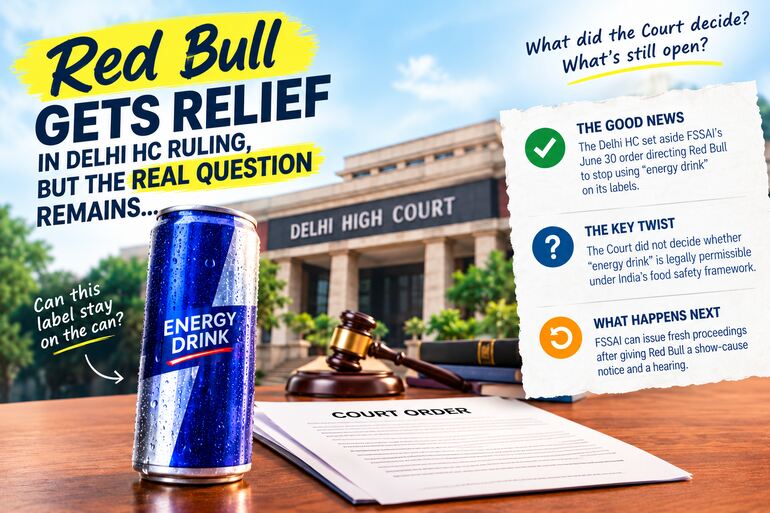
The Delhi High Court has set aside a June 30, 2026 order passed by the Food Safety and Standards Authority of India (FSSAI) that had directed Red Bull India Private Limited to stop using the term “energy drink” on its product labels. In a September 29, 2026 order, Justice Shri Amit Mahajan held that the regulator had passed the direction without giving Red Bull an opportunity to respond, violating principles of natural justice.
The ruling grants Red Bull immediate relief from the ban on the “energy drink” descriptor, but it does not decide the substantive question of whether the term can legally be used under India’s food safety framework. The court expressly left open the merits of the dispute and allowed FSSAI to pass fresh orders after issuing a show-cause notice and granting Red Bull a hearing.
How The Dispute Reached The Delhi High Court
The immediate trigger was an FSSAI order dated June 30, 2026 issued by an assistant director directing Red Bull to discontinue the use of “Energy Drink” on its caffeinated beverages. The regulator’s broader enforcement drive, which also covered companies such as PepsiCo, Monster and others was based on the position that there is no recognized “energy drink” category under the Food Safety and Standards Act, 2006, and that certain claims like “vitalises body and mind” are misleading.
Red Bull challenged the order before the Delhi High Court in W.P.(C) 14413/2026, arguing that the directive had been issued without prior notice or an opportunity to be heard. The company also highlighted that its product has been sold in India since 2002 under the same description, so any regulatory action would have significant consequences for its packaging, labelling, distribution and consumer recognition.
During hearings on September 28, the court questioned whether FSSAI had served a show-cause notice or granted a hearing before passing the June 30 order. The matter was listed for further hearing on September 29, when the final order was delivered.
Also Read: PM Surya Ghar Adds a New Consumer Approval Checkpoint Before Rooftop Solar Installation
Why the court set aside the FSSAI order
The Delhi High Court’s decision turned on procedure rather than the technical classification of the beverage. Justice Mahajan noted that the June 30 order carried serious civil consequences for Red Bull and its employees, affecting an established product that has been on the market for more than two decades.
The court held that a statutory authority cannot pass an order with such consequences without affording the affected party an opportunity of hearing or representation, unless there is an extreme emergency that justifies dispensing with that requirement. It found that no such emergency existed in this case and that Red Bull had not been given a chance to file a reply or explain its position before the impugned order was issued.
Accordingly, the court set aside the June 30 FSSAI order and all consequential steps taken pursuant to it, including a July 17 communication that had instructed state and Union Territory food safety authorities to take action against non-compliant products.
What The Judgment Does And Does Not Decide
The order is significant for what it does not decide as much as for what it does. The court clarified that it had not examined the merits of whether Red Bull’s product or its labelling violates any provision of the Food Safety and Standards Act, 2006. It also specifically declined to rule on whether FSSAI has the power to direct Red Bull to discontinue the term “energy drink”.
In effect, Red Bull has won this round on procedural grounds, not a final victory on the underlying regulatory question. The judgment preserves FSSAI’s authority to regulate product descriptions and labelling, while insisting that any such action must follow due process.
Also Read: Swastika Infra’s ₹916.55 Cr Pipeline Is Now in Focus After 7.60x IPO Demand
What FSSAI Can Do Next
The court granted FSSAI liberty to pass fresh orders on the issue, but only after complying with principles of natural justice. This means the regulator can reconsider whether Red Bull’s product and its labelling comply with the applicable food safety framework, but it must first issue a show-cause notice and give Red Bull an opportunity to be heard.
Reports indicate that FSSAI plans to appeal the decision on public health grounds, even as it retains the option to initiate fresh proceedings against Red Bull and other beverage makers. The regulator has previously stated that high-caffeine products should be described as “caffeinated beverages” rather than “energy drinks”, and that labels, marketing and ad campaigns using the term “energy” should be withdrawn within a specified timeline.
If FSSAI issues a fresh notice or order, the substantive question that the High Court deliberately left unanswered, whether the term “energy drink” can continue to be used for Red Bull’s product under India’s food safety framework could return to the centre of the dispute.
Why The “Energy Drink” Label Matters For The Industry
The dispute sits against a broader regulatory backdrop involving how beverages are categorized and described in India. In a March 2024 advisory, FSSAI had addressed the use of “Health Drinks” and “Energy Drinks” terminology on e-commerce platforms, stating that the expression “Energy” could be used for products licensed under specified food categories, including relevant carbonated and non-carbonated water-based flavoured beverages.
The latest enforcement position however treats “energy drink” as an unrecognized category and objects to certain functional claims. For companies operating in India’s large packaged food and beverage market, the distinction is not merely about marketing language. It can affect packaging design, labelling compliance, distribution arrangements, inventory management, consumer recognition and overall regulatory risk.
The Delhi High Court’s September 29 order therefore has implications beyond Red Bull. It reinforces that regulatory decisions with serious commercial consequences must be preceded by notice and hearing, even in fast-moving enforcement drives targeting multiple players in a category.
A Regulatory Question That Remains Open
For now, Red Bull can continue using the “energy drink” description on its products, subject to any future orders by FSSAI passed in accordance with due process. The September 29 judgment establishes a narrower but important principle: a regulatory decision carrying serious consequences cannot bypass the affected company’s opportunity to respond.
The next phase of the dispute will likely focus on whether FSSAI issues a fresh show cause notice and if so, how it justifies its position on the “energy drink” label under the existing food safety standards. That subsequent decision and any further legal challenge it may attract could prove more consequential than the order that has just been set aside.
References:
- Delhi High Court order in Red Bull India Private Limited v. Union of India & Ors. (W.P.(C) 14413/2026), September 29, 2026.
- Food Safety and Standards Authority of India (FSSAI) advisory on “Health Drinks” and “Energy Drinks”, March 2024.
