



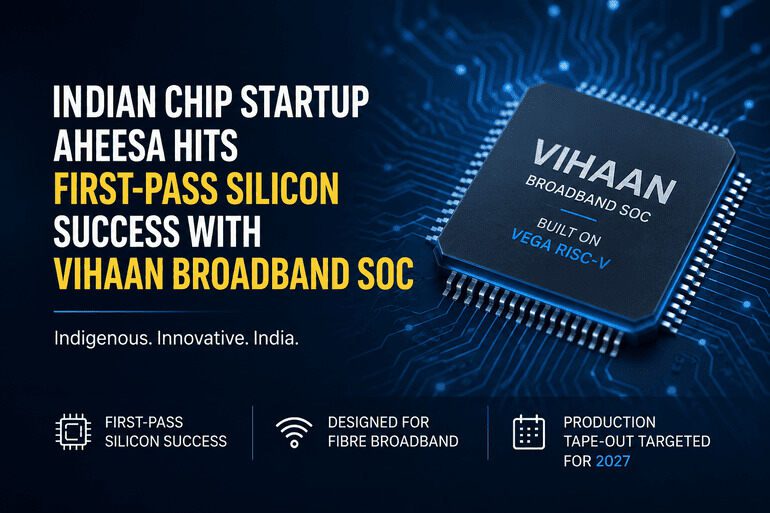
Chennai-based semiconductor startup Aheesa Digital Innovations has achieved first-pass silicon success with VIHAAN, an indigenous broadband networking System-on-Chip (SoC) built around the VEGA RISC-V processor. The milestone puts the company a step closer to commercializing its homegrown chip for fibre broadband applications. Aheesa is now targeting production tape-out for 2027.
Aheesa taped out VIHAAN on 26th January on Republic Day before achieving first-pass silicon success on August 15, Independence Day. The chip is designed to support fibre broadband infrastructure and networking applications. VIHAAN is built around the 64-bit VEGA processor, an indigenous RISC-V-based processor developed by C-DAC. The SoC brings together processing and networking capabilities aimed at broadband equipment, with the company developing it as an Indian alternative for fibre-access applications.
The achievement is significant because first-pass silicon success means the initial fabricated version of the chip has successfully demonstrated its intended functionality. For a semiconductor startup, reaching this stage reduces the risk of requiring a major redesign before moving towards production.
Also Read: PM Modi’s 2047 Vision Puts Chips, Energy and Critical Minerals in Focus
Fresh Funding Fuels Aheesa’s Semiconductor Ambitions
The silicon milestone follows fresh funding for Aheesa earlier this year. The Chennai-based startup raised around ₹40 crore from the Tamil Nadu Infrastructure Fund Management Corporation (TNIFMC) through the Tamil Nadu Emerging Sector Seed Fund (TNESSF), along with other private investors. The funding is being used to accelerate product development and support Aheesa’s growth in the semiconductor sector.
VIHAAN targets India’s Fibre Broadband Market
Aheesa is developing VIHAAN for the growing fibre broadband ecosystem, where networking chips play a key role in connecting homes and businesses to high-speed fibre networks.
Earlier government material described VIHAAN as a VEGA-based GPON Optical Network Terminal and Network SoC integrating fibre termination, data processing and network management functions. The platform is also designed with networking interfaces and security features for broadband applications.
The company now faces the next stage of development: taking the validated silicon through production and towards customer deployment.
Also Read: 440 Startups, More Rockets: India’s Private Space Sector Enters a New Phase
Another Milestone for India’s Chip Ecosystem
Aheesa’s progress comes as more Indian semiconductor startups move from chip design and tape-out to working silicon. Companies supported under the Design Linked Incentive (DLI) Scheme have collectively raised more than $100 million in venture capital funding, while achieving more than 30 design tape-outs across foundries. The broader ecosystem includes startups working on chips for AI, automotive systems, surveillance, telecommunications, IoT and other applications.
Other recent milestones include first-pass silicon success for a BLDC motor-controller chip from Vervesemi Microelectronics and the testing of a 12nm Vision SoC by Netrasemi. For Aheesa, however, the focus now shifts from proving VIHAAN in silicon to getting it ready for production.
With production tape-out targeted for 2027, the next phase will determine whether the Chennai startup can take its indigenous broadband chip from successful silicon validation into commercial networking products.
Source: Press Information Bureau, Government of India, August 15, 2026

1 Comment
Pingback: Point S Prepares the Workshop Leaders of Tomorrow