



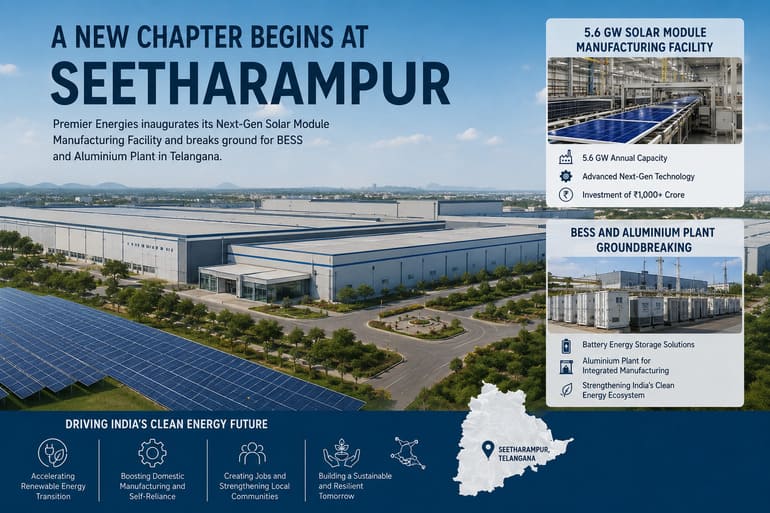
While most reports have focused on the inauguration of Premier Energies’ next-generation solar module manufacturing facility at Seetharampur in Telangana, the bigger story lies in what this investment represents for India’s renewable energy manufacturing ecosystem.
Spread across 75 acres and backed by an investment exceeding ₹1,000 crores, the project is more than an increase in production capacity. Alongside the inauguration of a 5.6 GW solar module manufacturing facility, the company also laid the foundation for a Battery Energy Storage System (BESS) plant and an aluminium manufacturing unit. Together, these three projects signal a broader strategy aimed at strengthening domestic manufacturing, supply chain integration and clean energy infrastructure.
Surender Pal Singh Saluja, Chairman, Premier Energies Ltd. described the inauguration of the Seetharampur facility as a significant milestone in the company’s 30-year journey. He highlighted that the new manufacturing campus reflects Premier Energies’ continued emphasis on technology-driven manufacturing, operational excellence and its long-term commitment to supporting India’s clean energy ambitions.
Sudhir Reddy, Director, Premier Energies Ltd. said the integrated campus forms part of the company’s broader strategy to build a technology-led clean energy manufacturing platform. According to him, the addition of the upcoming Battery Energy Storage System (BESS) and aluminium manufacturing facilities is expected to strengthen supply chain resilience while enabling the company to better address the evolving needs of the renewable energy sector.
More Than a New Solar Factory
India has witnessed rapid growth in solar installations over the past decade. However, manufacturing has often struggled to keep pace with rising demand. By adding another 5.6 GW of module manufacturing capacity, Premier Energies is contributing to the country’s efforts to expand domestic production and reduce dependence on imported components. As governments continue encouraging local manufacturing through various policy initiatives, investments like these could play an increasingly important role in making India a global renewable energy manufacturing hub.
Also Read: https://webnewsaddiction.com/rajesh-power-services-pgvcl-order/
Why Launch a BESS Plant Alongside a Solar Factory?
One of the most interesting aspects of Premier Energies’ announcement is that it extends beyond solar modules. Battery Energy Storage Systems (BESS) are becoming an essential part of renewable energy infrastructure because they help store electricity generated during peak solar hours for use when sunlight is unavailable.
As India’s renewable energy capacity continues to expand, energy storage is expected to become increasingly important for improving grid reliability and supporting round-the-clock clean power. The simultaneous development of a BESS facility suggests the company is looking beyond manufacturing modules and positioning itself within the broader renewable energy value chain.
The Aluminium Plant Could Be a Strategic Advantage
Another announcement that received comparatively less attention was the planned aluminium manufacturing facility. Aluminium plays an important role in solar module frames and structural components. Manufacturing this material closer to module production could potentially improve supply chain efficiency, reduce logistics costs and provide greater control over production timelines.
Although the long-term impact will depend on future execution, the combination of solar modules, battery storage and aluminium manufacturing indicates an integrated manufacturing approach rather than isolated capacity expansion.
Also Read: https://webnewsaddiction.com/garuda-aerospace-micron-instruments-defence-drones/
Why Telangana Continues to Attract Renewable Investments
Telangana has steadily emerged as one of India’s preferred destinations for renewable energy manufacturing. Its industrial infrastructure, connectivity, policy support and availability of skilled manpower have attracted investments from several clean energy companies over the years. The presence of senior government officials during the inauguration also highlights the state’s focus on strengthening advanced manufacturing and clean technology investments.
What This Means for India’s Solar Industry
The significance of the project extends beyond Premier Energies itself. India has set ambitious renewable energy targets while simultaneously promoting domestic manufacturing under initiatives aimed at reducing import dependence. Projects that integrate manufacturing, energy storage and supporting industries may become increasingly important as the country builds a more resilient clean energy supply chain. Rather than focusing solely on production capacity, companies are now looking at creating integrated manufacturing ecosystems capable of supporting long-term industry growth.
Key Highlights:
- Investment exceeding ₹1,000 crores;
- 75-acre manufacturing campus;
- 5.6 GW solar module manufacturing capacity;
- Groundbreaking for Battery Energy Storage System (BESS) plant;
- Foundation laid for aluminium manufacturing facility;
- Located at Seetharampur, Telangana;
- Supports India’s expanding renewable manufacturing ecosystem.
Looking Ahead
The inauguration marks another milestone in Premier Energies’ growth journey, but the broader significance lies in its integrated manufacturing strategy. By combining solar module production with battery energy storage and aluminium manufacturing, the company appears to be positioning itself for the next phase of India’s renewable energy transition.
As demand for domestically manufactured clean energy products continues to rise, projects that strengthen supply chains and improve manufacturing capabilities are likely to play an increasingly important role in supporting India’s long-term sustainability goals.
