



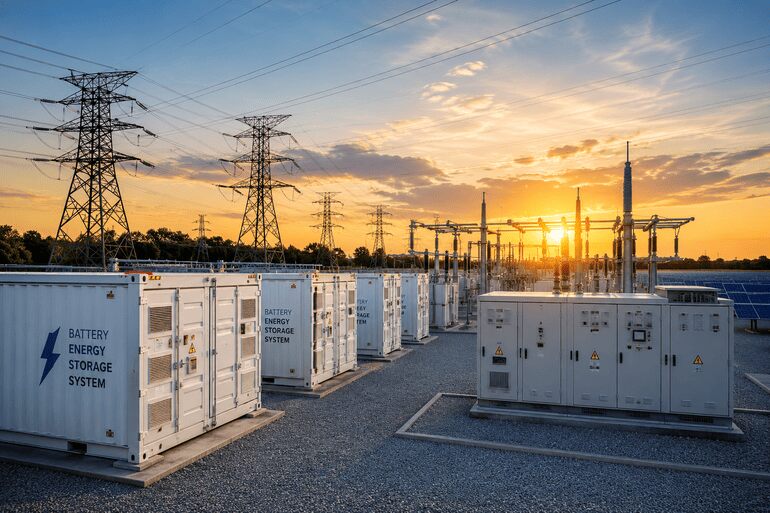
Battery Energy Storage Systems (BESS) are becoming an integral part of India’s evolving electricity infrastructure as utilities prepare their grids to accommodate higher levels of renewable energy. Reflecting this shift, MP Power Management Company Limited (MPPMCL) has invited bids for the development of 625 MW / 1,250 MWh of standalone Battery Energy Storage Systems (BESS) across Madhya Pradesh through a tariff-based competitive bidding process.
The tender represents another step in India’s growing investment in grid-scale energy storage, which is increasingly viewed as essential for improving grid flexibility, supporting renewable energy integration and strengthening the reliability of electricity supply.
A Strategic Investment in Grid Flexibility
Unlike conventional power plants, Battery Energy Storage Systems do not generate electricity. Instead, they store electricity when it is available and discharge it when required by the grid. This allows utilities to better manage fluctuations in renewable energy generation while ensuring reliable electricity supply during periods of higher demand.
As renewable energy capacity continues to expand, battery storage is emerging as a critical infrastructure asset that complements solar and wind generation by improving grid stability and operational flexibility.
Key Tender Highlights
According to the tender document, MPPMCL has invited bids for the development of 625 MW / 1,250 MWh of standalone Battery Energy Storage Systems under the Build, Own and Operate (BOO) model. The projects will receive support through the Government of India’s Viability Gap Funding (VGF) scheme, which aims to improve the commercial viability of large-scale battery storage projects while encouraging private sector participation.
Developers may bid for a minimum project size of 125 MW / 250 MWh, equivalent to a battery system capable of delivering 125 MW of electricity for two hours. Successful bidders will be responsible for designing, financing, constructing, owning, operating and maintaining the Battery Energy Storage Systems in accordance with the tender requirements.
The tender also places the responsibility for land identification and acquisition on the selected developers. According to the bid document, a 250 MW / 500 MWh project would require up to 15 acres of land, while a 125 MW / 250 MWh project would require up to 7.5 acres, preferably near the identified substations to facilitate grid connectivity. MPPMCL has clarified that land will not be allocated under the tender, making site selection and acquisition the responsibility of the developer.
MPPMCL has scheduled 30th July 2026 as the deadline for online bid submission until 3:00 PM, while hard copies of the bid documents must be submitted by 03rd August 2026 before 3:00 PM, as specified in the tender schedule.
Also Read: https://webnewsaddiction.com/india-grid-expansion-power-equipment/
How the Battery Storage System Will Operate
The tender also outlines the operational framework for the Battery Energy Storage Systems.
Under the proposed arrangement, the selected Battery Energy Storage System Developer (BESSD) will charge the battery systems using electricity supplied by MPPMCL through the interconnection point connected to the State Transmission Utility (STU) network. The stored electricity will subsequently be injected back into the transmission system in accordance with dispatch instructions issued by the State Load Dispatch Centre (SLDC) in consultation with MPPMCL.
The bidding document further specifies multiple charging and discharging sessions that define the minimum operational availability expected from the storage systems under different dispatch scenarios. These provisions are intended to provide operational flexibility while ensuring that the battery systems remain available to support grid requirements during different periods of the day.
Understanding the Project Capacity
For readers unfamiliar with Battery Energy Storage Systems, the tender specifies both power capacity and energy storage capacity. The 625 MW rating represents the maximum amount of power that can be supplied at any given moment, while 1,250 MWh indicates the total amount of energy that can be stored. In practical terms, this enables the storage systems to deliver their rated output for approximately 2 hours before requiring recharge. Similarly, the minimum project size of 125 MW / 250 MWh follows the same two-hour storage configuration.
The Tender’s Financial Framework
Battery Energy Storage Systems require substantial upfront investment, making project economics an important consideration for developers. To improve project viability, the tender provides Viability Gap Funding (VGF) support, helping offset part of the capital investment required for utility-scale battery storage.
The projects will also be implemented under the Build, Own and Operate (BOO) model, under which the selected developers will finance, construct, own and operate the Battery Energy Storage Systems while providing storage services in accordance with the contractual requirements of the tender.
The Growing Role of Battery Storage in India’s Power Grid
India’s renewable energy capacity has expanded significantly in recent years, bringing new challenges for electricity system operators. Unlike conventional thermal generation, solar and wind power depend on weather conditions and time of day, making flexibility increasingly important for maintaining a stable electricity supply.
Battery Energy Storage Systems address this challenge by storing surplus renewable electricity and supplying it back to the grid when required. This helps improve grid stability, manage peak demand, reduce renewable energy curtailment and strengthen the overall resilience of the power system. With more states announcing utility-scale battery storage projects, energy storage is steadily becoming an essential component of India’s clean energy transition.
A Shift in Grid Planning
Although MPPMCL’s latest announcement is a tender invitation, it also reflects a broader transformation taking place across India’s power sector. The focus is no longer limited to adding renewable generation capacity. Increasingly, utilities are investing in technologies that enable electricity to be stored, dispatched and managed more efficiently.
As battery storage deployment accelerates across the country, projects such as MPPMCL’s 625 MW / 1,250 MWh tender are expected to play an important role in building a more flexible, resilient and renewable-ready electricity grid.
