



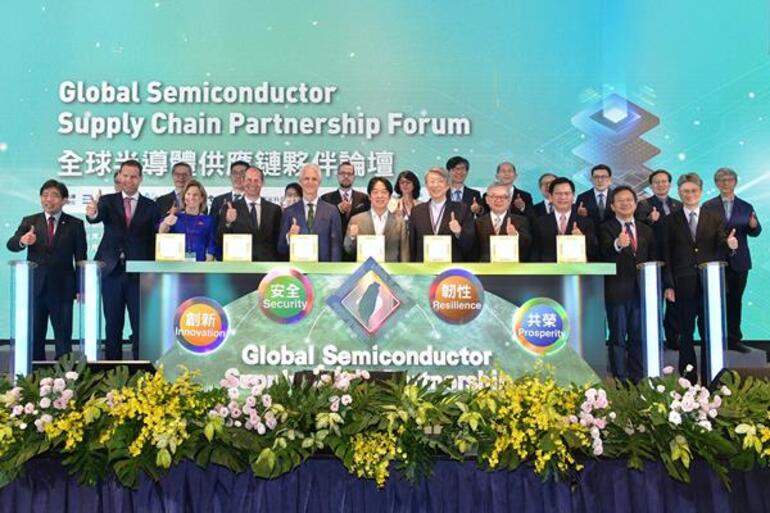
To address escalating geopolitical risks and evolving global supply chains, the Industrial Technology Research Institute (ITRI) hosted the Global Semiconductor Supply Chain Partnership Forum in Taipei on May 23. Aligned with Taiwan’s initiative to foster semiconductor supply chain partnerships among global democracies, the forum centered on the themes of Innovation, Security, Resilience, and Prosperity. Discussions focused on enhancing supply chain security, promoting international collaboration, and leveraging technological complementarity. The event drew more than 700 participants, including industry leaders, government officials, and representatives from foreign trade offices in Taiwan.
President Lai Ching-te stressed the need for democratic nations to unite against challenges such as unfair trade practices, emphasizing the importance of mutual strengths in securing a resilient semiconductor supply chain. He affirmed Taiwan’s readiness to be a cornerstone of technological advancement in the AI era. The government is supporting this vision through proactive policies, financial and tax incentives, and infrastructure investments—including data centers and supercomputers—to fuel industrial innovation.
Minister of Economic Affairs Jyh-Huei Kuo emphasized Taiwan’s pivotal role in the global semiconductor ecosystem. The Ministry is encouraging global supply chain partners to invest, co-develop the value chain, and explore emerging markets. Taiwan, he noted, will also work with like-minded democracies to establish credible, self-regulating market mechanisms that safeguard trusted supply chains. The Ministry will further advance cross-border talent initiatives to link Taiwan’s strong semiconductor workforce with the world and boost the competitiveness of democratic supply chain partners.
“Semiconductors are now a core strategic asset in global economic and technological competition, requiring deeply interdependent supply chains, ” said ITRI President Edwin Liu. “ITRI will focus on potential niche markets, drive key technology development, and strengthen global partnerships to enhance supply chain transparency, cybersecurity, and adaptability. We will work closely with partners worldwide–from materials and manufacturing to talent development–to explore innovation and “blue ocean” opportunities. Our goal is to build an open, inclusive semiconductor ecosystem where all partners can create value and share in the success.”
“The United States and Taiwan share a long-standing, symbiotic relationship in the high-tech sector with semiconductors at its core,” said Jeremy Cornforth, Deputy Director at American Institute in Taiwan. He emphasized the growing two-way investment, joint efforts to strengthen supply chain resilience and technology security, and a shared commitment to building a strong and innovative global semiconductor ecosystem.
