



Gujarat Alkalies and Chemicals Limited (GACL) has partnered with Fourth Partner Energy (FPEL) to develop an approximately 45 MW wind-solar hybrid renewable energy project in Gujarat. The GACL renewable energy initiative will combine 19.8 MW of wind power and 25 MWp of solar capacity to supply clean electricity for the chemical manufacturer’s captive consumption.
The project will be developed through FPEL Bhanu Private Limited, a special purpose vehicle (SPV) and subsidiary of Fourth Partner Energy. Under the proposed arrangement, GACL will acquire a 26% equity stake in the SPV, while Fourth Partner Energy will retain the remaining 74% shareholding. Both companies will invest in the project in the same 26:74 ratio.
The proposed hybrid facility will have a solar capacity of 25 MWp, equivalent to approximately 19.25 MW on an AC basis, alongside 19.8 MW of wind power. The combined installed capacity will therefore be approximately 44.8 MW on an AC basis.
As part of the arrangement, the companies have entered into multiple agreements, including a Share Purchase Agreement, Shareholders’ Agreement and Power Consumption Agreement to establish the framework for developing and operating the project.
The entire electricity generated by the facility will be consumed by GACL to meet its captive power requirements. The arrangement is expected to help the company increase renewable electricity consumption, diversify its energy sources and reduce dependence on conventional power.
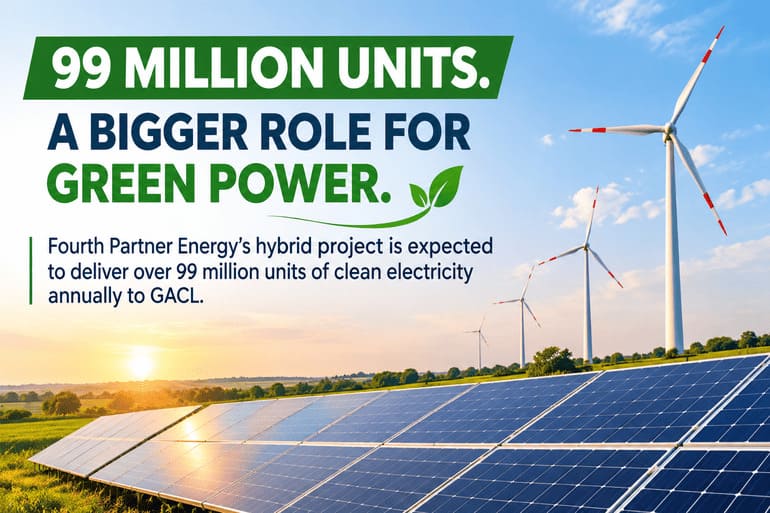
Fourth Partner Energy has identified the agreement as its largest contract in Gujarat to date. According to the company, the hybrid project is expected to generate more than 99 million units of clean electricity annually, supporting GACL’s decarbonization and energy transition objectives.
Commenting on the partnership, Mr. PT Devaraj, Head of Business Development (India) and Mr. Kushal Mamgain, Head of Business Development (West Zone) at Fourth Partner Energy highlighted the growing interest among industrial consumers in wind-solar hybrid solutions. They also noted that combining hybrid renewable energy projects with battery energy storage systems (BESS) could play an important role in shaping corporate renewable energy procurement strategies in India.
The partnership marks another development in the adoption of captive renewable energy solutions by energy-intensive industries, as companies increasingly explore hybrid power arrangements to support their sustainability commitments.
